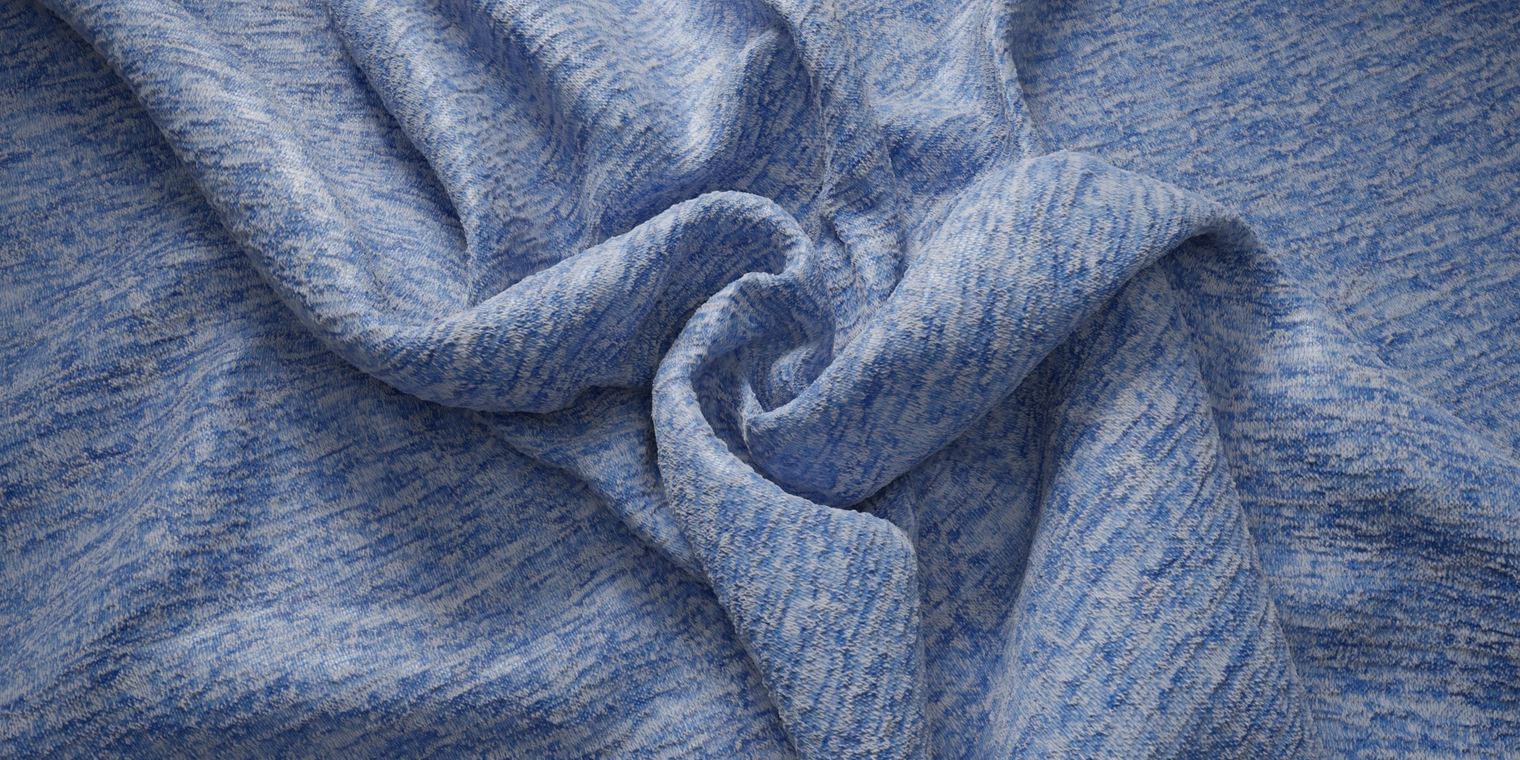
When Saeed Al-Rubeyi, co-founder of Story MFG, inspects natural indigo-dyed textiles, he buries his face in them and takes a deep breath to give his seal of approval. This isn't a scientific inspection, per se, but it can be a valuable starting point. Natural indigo has a very distinct smell, resulting from the bacterial fermentation required to develop a vat of the dye from its leafy origins. Saeed was caught off guard the first time he saw someone do this. The man was searching for evidence of nature in the dyeing process, much as one might smell cheese or wine to gauge its authenticity.
In fact, indigotin is insoluble and can't dye anything in its native form. A working indigo vat is a yellow-green color topped with a coppery foam that signals the bacteria in the vat are alive and well and that the fermentation process is underway. The cloth comes out of the vat the same sickly yellow-green you can see in it. The real magic comes after pulling the cloth out of the vat, once it hits the air. Starting wherever oxygen first reaches, a visible color front begins moving across the cloth. In the span of a few minutes, the cloth transforms from a yellow-green to a muddy green to teal, to the characteristic blue that indigo is famous for.
This smell test wouldn't work, however, if one were inspecting a Turkish Red or dusty pink madder-dyed fabric. The color compounds in madder root build in strength through heat and time in a single bath and do not require any fermentation processes, though alum is used to enhance bonding. The process is tame in comparison. The cloth sits in a warm bath and gradually deepens in color, more like steeping tea than a mysterious transformation. It's a one-and-done type process, as opposed to indigo dyeing, which can require immersing the cloth a dozen or more times into the dye vat to reach the desired color.
Many factors affect how well a fiber or cloth takes up natural dyes. In this article, I will focus on the three types of natural dyes and the chemistry that governs their bonding. The reason indigo requires such extensive processing and maintenance to act as a dye, and madder does not, is a matter of the dye molecule's properties.
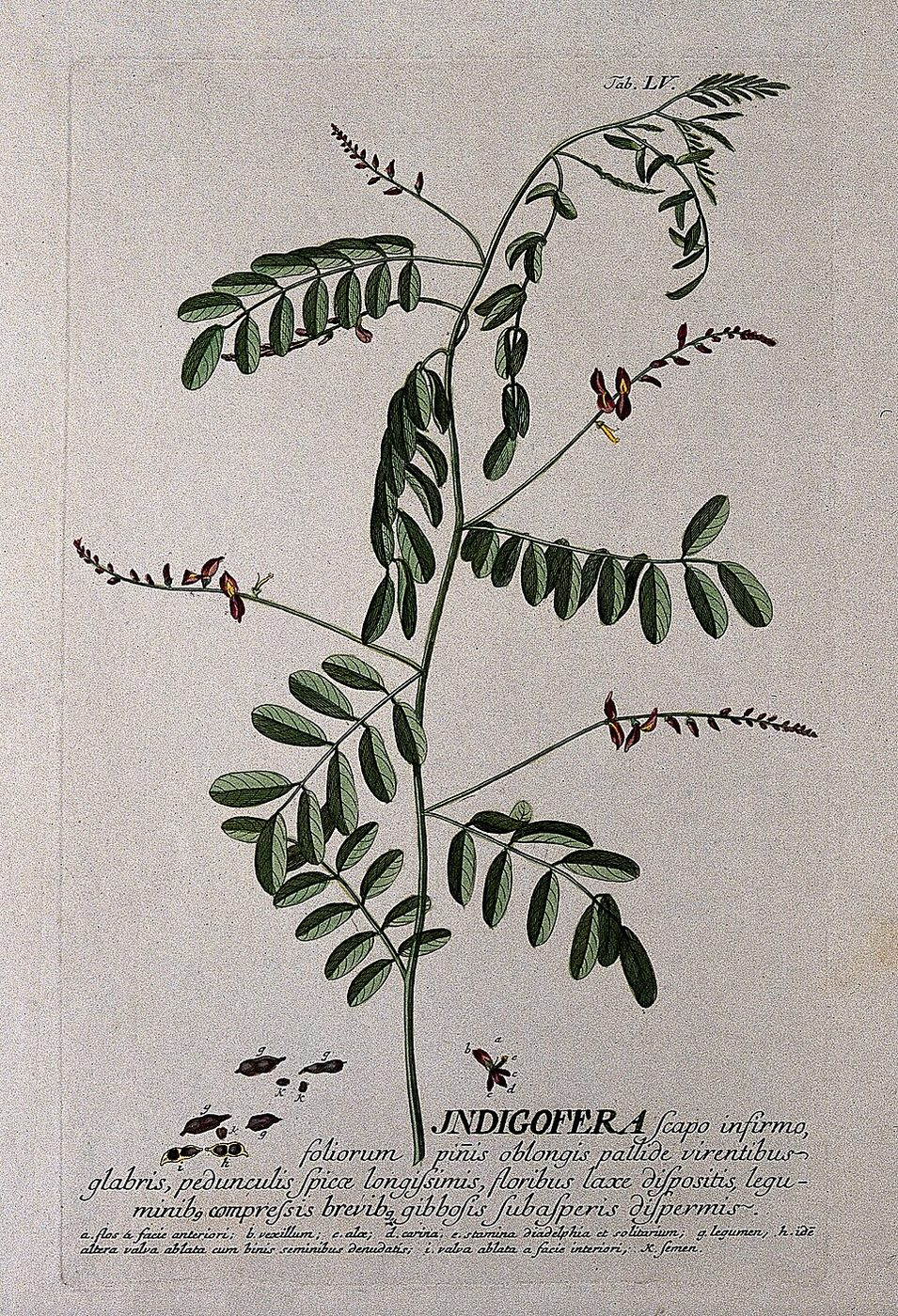
There are three broad categories of dyes, based on their chemical compositions, which affect how they bond with fiber. The first category is the vat dyes, also known as the indigoid category. Dyes within this category include indigo, woad, and Tyrian purple. All of these dyestuffs contain the same active compound: indigotin. Indigotin is such a special molecule that it comprises its own category of dyes. This molecule has been duplicated throughout nature, in unrelated plant species and across continents. Humans on different continents independently discovered methods for extraction and use.
Vat Dyes: Color Through Reduction and Oxidation
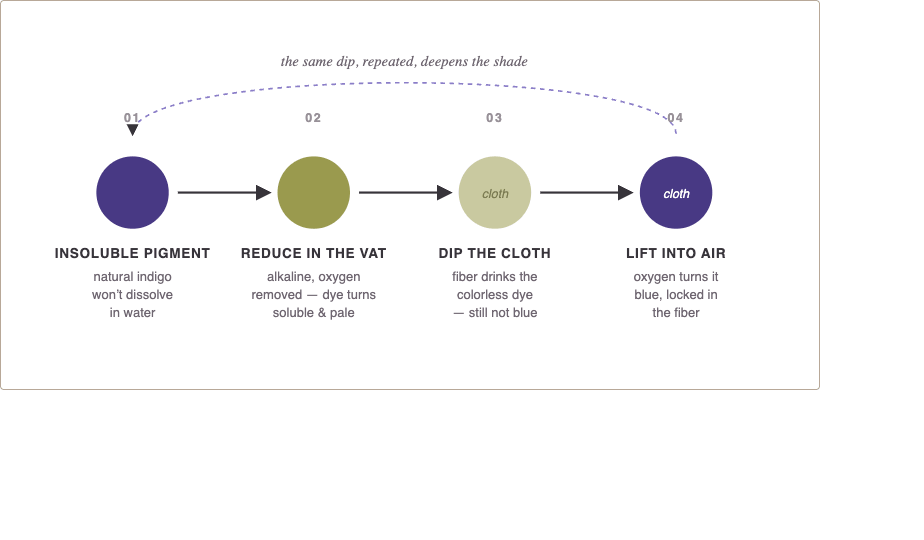
The primary property of indigotin that differentiates it from other dyes is its insolubility. The indigotin molecule is highly conjugated and held together by hydrogen bonding between its carbonyl (C=O) and N-H groups. In practical terms, that means the indigotin molecule would prefer to remain bound to itself rather than dissolve in water. The result is a hydrophobic crystalline solid that's insoluble in water. If you dump powdered indigo into a tub and add cloth, nothing would transfer to the cloth.
To make indigotin usable, it must be chemically reduced, meaning electrons must be added to the molecule. This is accomplished by bacterial metabolism in an alkaline vat (typically at a pH between 9.5 and 11, maintained with lye, wood ash, or stale urine). The alkaline vat hosts facultative anaerobic bacteria, which can switch between aerobic and anaerobic metabolism depending on their environment. These bacteria will deplete the oxygen in the vat and begin anaerobic metabolism, generating electron carriers such as NADH. Electrons from NADH are transferred to the indigotin molecule, converting its carbonyl groups into hydroxyl groups and collapsing the hydrogen bonds that hold the crystal structure together. This reduction yields a molecule called leuco-indigo ("leuco" meaning colorless or pale), which is water-soluble in alkaline solution.
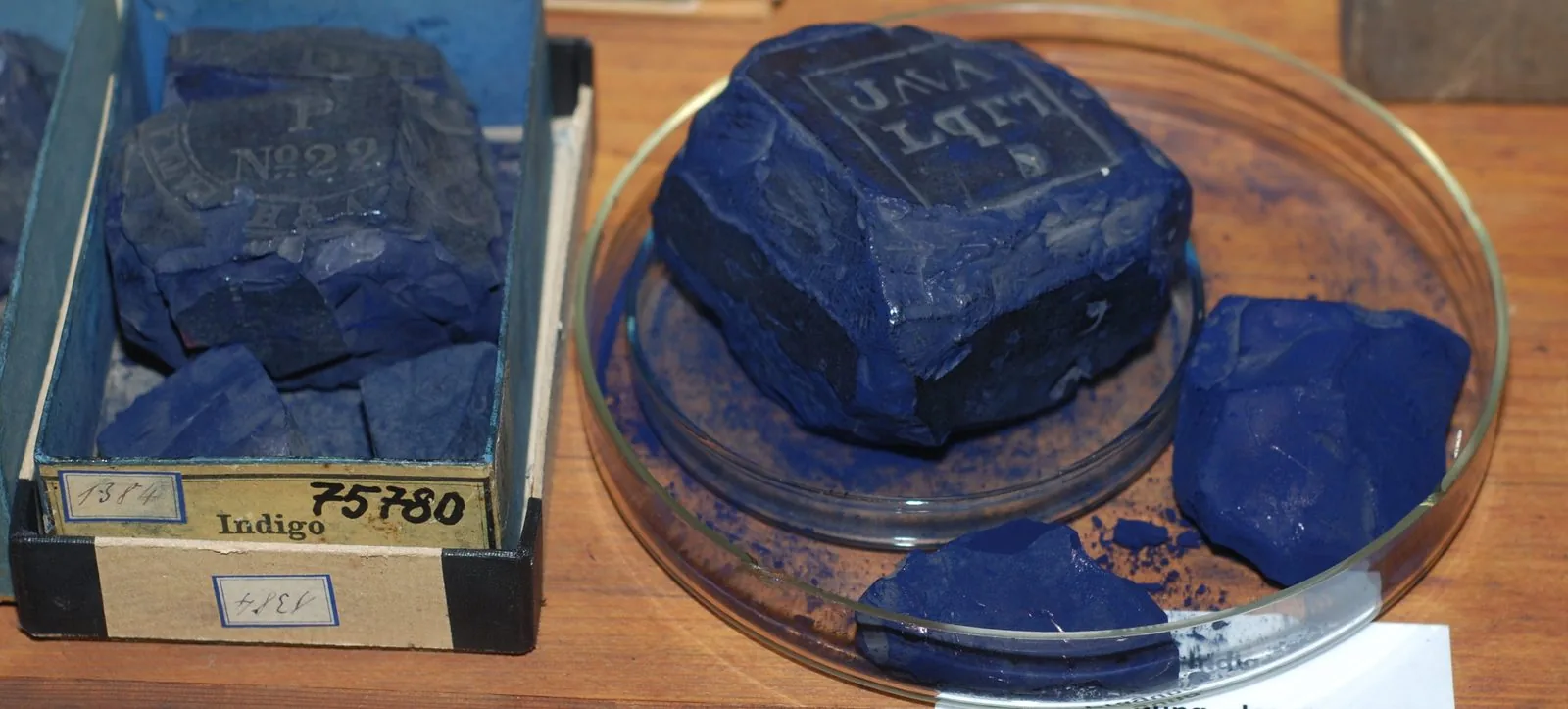
The dye vat needs to be both alkaline and reducing simultaneously to accomplish this process. The reduction process transforms indigo into leuco-indigo, and the high pH of the alkaline solution allows it to ionize, becoming water-soluble. If the pH drops too low, the indigo will precipitate back out. Vat maintenance is an art form that requires a delicate balance among these factors to ensure optimal conditions for dyeing. The color of the coppery foam ("flower" or handate) and the smell of the vat indicate the vat's health to the artisans who practice the craft.
Because leuco-indigo is water-soluble, it can penetrate fibers the same way a traditional water-soluble dye would. However, the color imparted to the fiber is the same yellow-green as the vat liquid itself. Dyers must quickly remove and wring dry the fabric to ensure that the leuco-indigo is evenly distributed throughout; if one area of the fabric is more saturated than others, it can trigger oxidation and create uneven coloration.
Oxidation is the true hero of the indigo dyeing process. Once the cloth is removed from the vat and exposed to oxygen, the reverse chemical reaction begins. The hydroxyl groups are reoxidized to carbonyl groups, the hydrogen bonds reassemble, and the leuco-indigo reverts to insoluble, hydrophobic indigotin. Because this occurs while the dye is bound within the fiber's physical structure, the indigotin crystallizes in place and is mechanically trapped within the fibers rather than chemically bound to them. This reverse reaction results in a visible color change, with the yellow-green fabric shifting to true indigo blue as oxidation occurs.
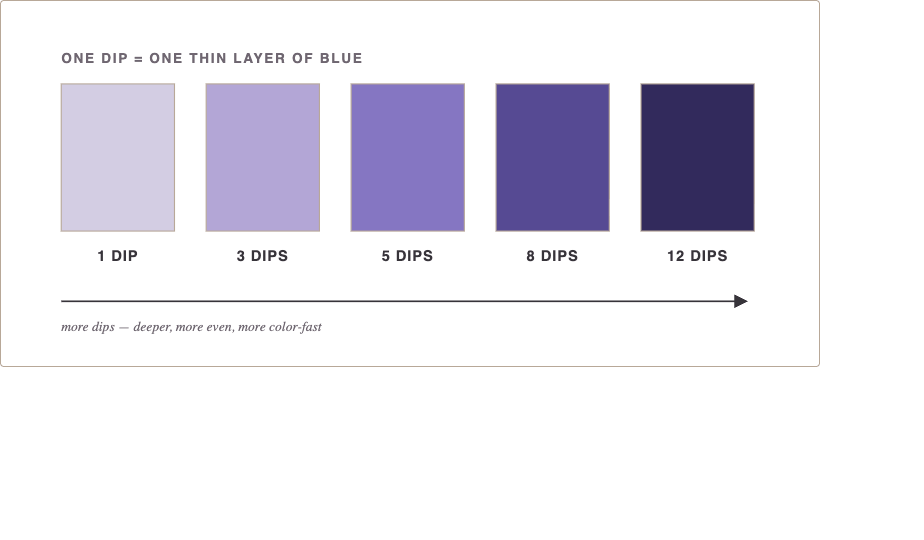
A single dip-and-oxidize cycle deposits only a thin layer of trapped indigotin, resulting in a pale blue color. Getting a garment or fabric to a deep indigo color requires repeating this process 10 to 50 times, depending on the desired color and the concentration of indigotin in the vat.
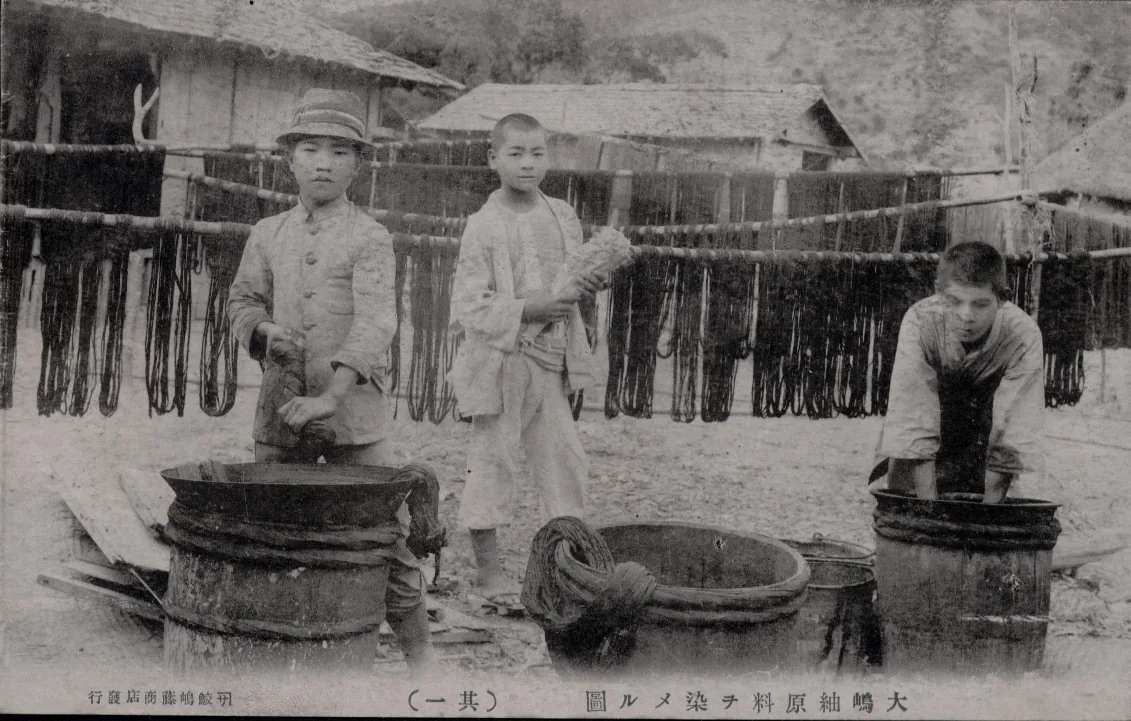
The process of preparing the indigo vat — alkalinization, aerobic depletion, anaerobic onset, and full reduction — can take anywhere from 7 to 40 days, depending on how well the vat is tended (temperature, pH, etc.). Depending on the fiber used, the dip process inside the vat can take anywhere from 10 minutes to an hour. Oxidation begins within seconds of removal from the vat, but full oxidation takes between 20 and 30 minutes. Drying the cloth between dips is not strictly necessary, but many dyehouses prefer to allow time between dips, and often allow at least 24 hours from the completion of one day's work to the beginning of a new session. This translates roughly to a 10-17-day timeline to complete the dyeing process, depending on how much time is allowed between dips.
All of this is not to mention the 120 days of fermentation and 60 days of drying it takes to transform the indigo plant into a usable dyestuff. I'll cover that in a separate article. Vat dyeing is truly a labor of love and an expression of honor and cultural heritage for those artisans who keep the practice alive. It's easy to see how garments dyed with natural indigo can cost ten times as much as mass-made garments dyed with synthetic dyes. The decades of skill, knowledge, and labor required to master vat dyeing are hard to find and are becoming rarer as the years pass.
Mordant Dyes: Building a Chemical Bridge
The second broad category of dyestuffs is known as mordant dyes. A few dyes that fall into this category are madder (active molecule alizarin), weld (luteolin), and onion skins (quercetin). Unlike vat dyes, these molecules are already water-soluble. However, a molecule that's happy to be dissolved in water has no particular reason to leave the water and instead sit inside the fiber. Even if some dye molecules diffuse into the fiber inside the dye bath, there is nothing to keep them there. The moment you wash or rinse the cloth, the dye will migrate right back into the water.
The common element between dyes within this class that renders them valuable dyestuffs is the presence of free hydroxyl groups on the molecule. This hydroxyl group makes the dye molecule susceptible to deprotonization. This is accomplished using a mordant. A mordant is a metal salt — most commonly aluminum, iron, or tin in dye chemistry — that creates a chemical bridge between a dye molecule and a fiber that otherwise would have no incentive to bind directly. The metal pulls hard enough that the oxygen releases its proton and binds to the metal instead, while also binding the fiber. This process is known as chelation. The word mordant comes from the Latin mordere, meaning "to bite," an apt description as the metal salt bites onto both the fiber and dye at once to hold them together.
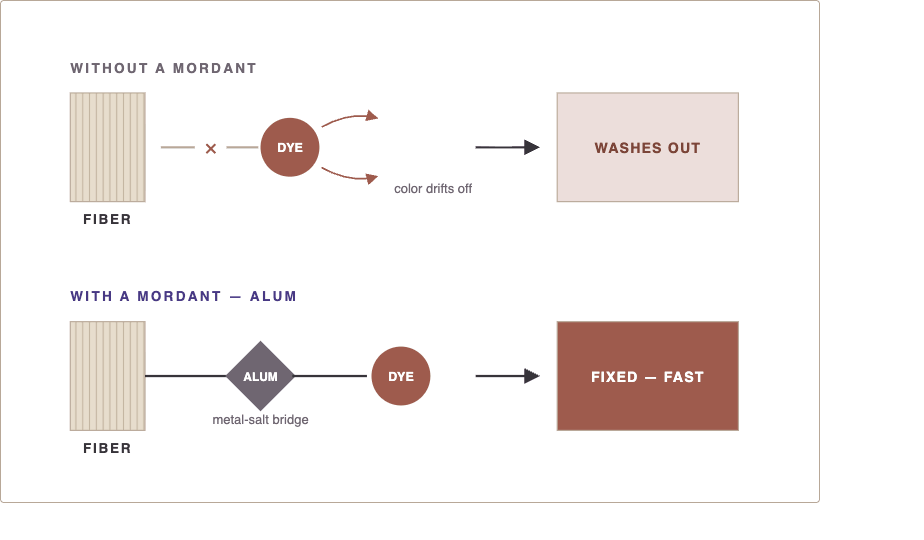
The choice of mordant impacts the color that a dye produces. The differences come down to whether the metal has its own electrons that absorb light. Aluminum has no d-electrons able to participate in light absorption. Therefore, when alum chelates onto a dye, the color of the resulting complex comes almost entirely from the dye, undiluted and unshifted from its original or "native" color. Madder combined with alum results in Turkey red, one of the most prized colors in the natural dye world. If you were to use iron as your mordant instead, the resulting color would be a dark purple to a near-black, often called "alizarin blue-black." This is a result of iron's own d-electrons that absorb light on top of what the dye itself absorbs, which darkens or dulls the resulting color, a process known as "saddening." Other examples include tin, which brightens or warms towards an orange-red, and copper, which pushes towards green/olive tones.
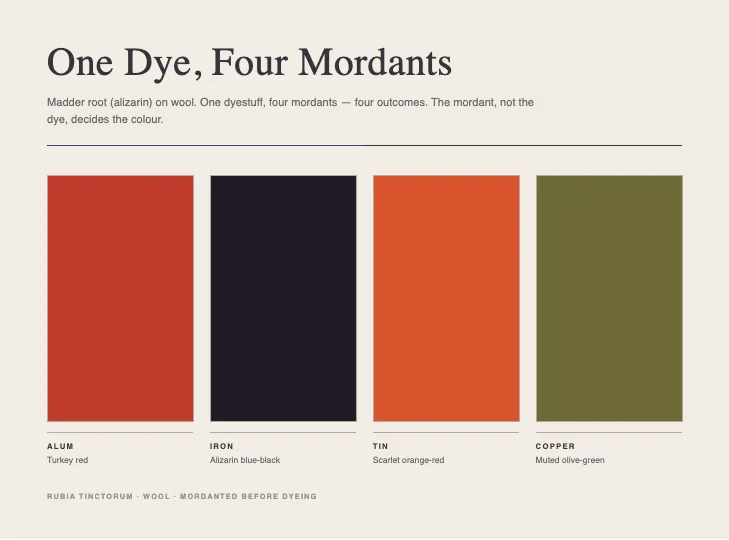
Fiber is immersed in a bath containing only the metal salt (alum, iron, tin, etc.) dissolved in water and then allowed to simmer for an hour or more. This results in no visible change to the fiber, as no dye has been added, but it primes the fiber by chelating metal ions. At the same time, a separate bath is created containing the dyestuff and allowed to simmer to pull the dye molecules into the solution. Think of this like steeping a cup of tea. Afterward, the two baths are combined into one, allowing the dye to chelate with the fiber and the color to develop. Once the two baths are combined, a dye bath simmer typically takes between 30 minutes and an hour. This process, known as "pre-mordanting," is the standard approach for mordant dyeing as it is the most predictable and controllable. Another option is "meta-mordanting," in which the mordant and dye are combined in a single bath. This is faster but less predictable as the metal has to negotiate both binding partners at once. The final option is "post-mordanting," in which the fiber is dyed first and then placed in a mordant bath afterward.
Mordant dyeing is fundamentally a one-and-done process, in contrast to the 10-50 dips required for vat dyeing. Once mordanted fiber is placed in a simmering dye bath, the dye molecules in solution have only a fixed number of chelation sites on the fiber to which they can bind. Given enough time at the correct heat, generally 30 minutes to an hour, the sites will be fully bound, and no further work is needed. Since indigotin is not chemically bound to fibers, the vat dye process requires much more work to achieve the same depth of color.
The word mordant comes from the Latin mordere, meaning "to bite."
The depth of color for vat dyeing is a product of the number of dips. For mordant dyes, the depth of color must be controlled in other ways. The main method is by controlling the dye-to-fiber ratio. Dyers use "weight-of-fiber" (WOF) percentages to control color. The WOF is the weight of the dyestuff expressed as a percentage of the dry fiber weight. For example, a recipe might call for 20% WOF madder for a medium shade and 50% for a saturated one. More dyestuff relative to fiber means more dye molecules are available in the bath to compete for chelation sites. The ceiling, however, is determined by the mordant and not the dye. The number of chelation sites on the fiber depends on the amount of mordant in the dye bath. Although the process of mordant dyeing is simpler, it is less forgiving, as the depth of color must be determined in advance, whereas vat dyeing allows the dyer to stop when they reach the desired hue.
Direct Dyes: The Simplest Path to Color
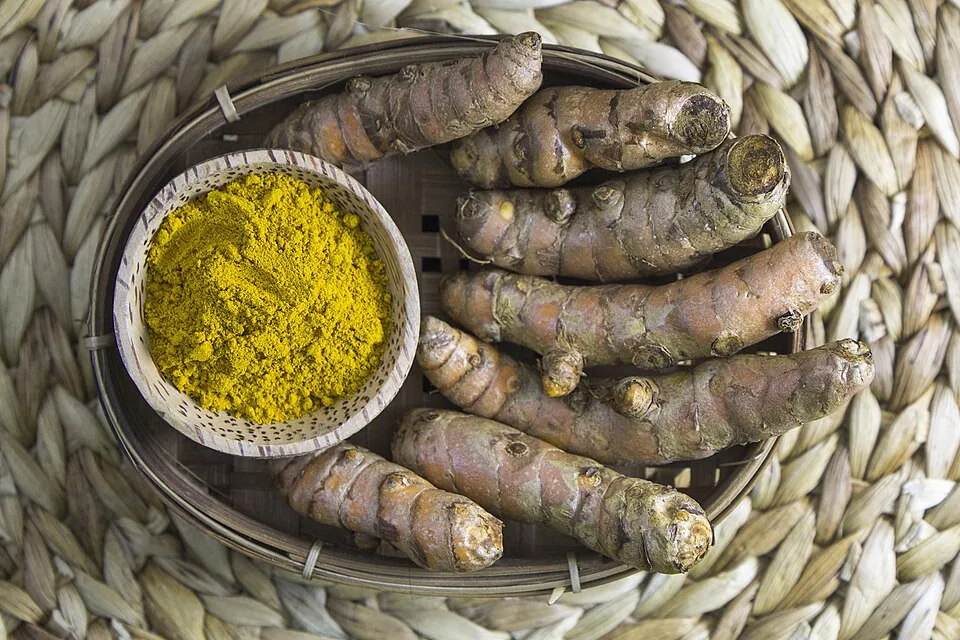
The final broad category of natural dyes is the direct dyes. A few examples of dyestuffs within this category are turmeric (active molecule curcumin), henna (lawsone), and walnut hull (juglone). This category is very similar to mordant dyes in that they are both water-soluble to begin with. The difference between these two types of dyes is that direct dyes can bind to fiber without the addition of a mordant. In the case of turmeric, hydroxyl and carbonyl groups enable hydrogen bonding with the surface fiber. This is a very weak bond as there's no chelation or covalent bonding that locks the dye to the fiber, either mechanically or chemically. The colorant is mainly held to the fiber by surface adsorption. Turmeric is the textbook example of a fugitive dye, meaning a dye that's not permanent or colorfast. It's instant, cheap, and disappears at the first wash.
The counter to this weak dye attraction is henna and walnut. Lawsone (henna) and juglone (walnut) are nearly twins. The chemistry behind these two is a little over my head, but suffice it to say that both of these molecules feature a quinone ring that scientists term a "doubly activated Michael acceptor," which in practice just means they're very eager to form permanent bonds with fibers. This readiness to bond explains why henna will dye your skin or hair for weeks or why walnut stains your hands almost as permanently as it stains wool or silk.
Henna's durability is the reason it's survived as a dye for over 5,000 years. Bridal mehndi traditions across South Asia and the Middle East depend on the dye's ability to bond without a mordant. There's no metal salt, no simmering bath, just paste and time, and the stain holds for weeks.
Turmeric and henna land at opposite ends of the durability spectrum. The difference lies entirely in whether the molecule has something to grab onto. Turmeric's hydroxyl and carbonyl groups can only manage weak hydrogen bonds with the fiber surface so nothing actually locks in place, and then the first wash undoes it. Henna and walnut's quinone rings form an actual covalent bond with free amine groups instead.
The physical process of dyeing with direct dyes is simple, which is where the category earns its name. First, you simmer the dyestuff (turmeric powder, henna leaves, walnut hulls) to dissolve the colorant. You next strain out the dyestuff, then add the fiber directly to the dye bath. Rinse the fiber, and you're done. No mordant bath beforehand, no priming, no dozen-plus dips. Direct dyes skip every piece of infrastructure the other two categories need. Depth of color is controlled the same way you'd control tea strength: more dyestuff and more time in the bath. There's no fixed number of chelation sites that put a ceiling on how much pigment the fiber can hold. That absence of a ceiling means that it's the fastest, simplest process of the three categories, and also the one with the least control once the bath is dark enough.
Three Chemistries, Three Different Relationships with Fiber
Three categories with three different relationships between dye and fiber. Indigo never bonds to anything; it just gets trapped mechanically, mid-collapse from soluble to solid. Madder and its relatives bond hard, but only with a metal chaperone willing to bite into both sides at once. Turmeric bonds to nothing in particular, which is why it's gone by the second wash, while henna and walnut hold on through a chemistry closer to mordanting. None of this happens in a vacuum, though. The fiber plays a role too. Wool takes a mordant differently than cotton does, for reasons that have nothing to do with the dye molecule and everything to do with what the fiber is made of. That's where we pick up next: protein versus cellulose, and why a tannin bath can make cotton act like wool just long enough to take a dye it has no interest in holding. After that, I'll cover where these dyes actually came from, and where, if anywhere, they still survive.