Roy Slaper was a metal fabricator in Oakland who had decided, without being able to explain why, that he was going to make jeans. The machines came one at a time, and a studio apartment only holds so much. So the furniture went. Couch, table, bed, all out the door, replaced by more than a dozen industrial sewing machines. Roy even sold his cards, bikes, and guitars. He cut a piece of foam to fit the closet floor and slept on that. When people came by to collect the furniture and asked what he was doing, he said their reaction was roughly what you would get if your apartment were overrun with cats and you explained that you needed room for more cats.
He did not move into a proper workshop because he ran out of space. He moved because he realized how noisy he was being and didn’t want to disturb his neighbors.
Roy Slaper died on July 13th, 2026, according to his friends, at age fifty-five. The cause has not been made public, and I am not going to speculate about it. What I want to do instead is tell you how he worked, because a week out, the internet has mostly failed at that. The first page of results for his name is currently an abyss of auto-generated obituary pages, all recycling the same paragraph and several openly fishing for traffic on how he died. The man himself cut and sewed every garment that carried his name. He deserves a better record than that.
Roy’s origin story is not about starting a business. He bought his first machine from a man named Richard, who refused to complete the sale until he understood what he was dealing with. Roy told the story to Leafbox in 2010, when almost nobody outside forums knew who he was:
He said, ‘Wait, wait, wait — why are you doing this?’ What he wanted to know was whether I was motivated by money or if, as he put it, ‘Ok, good, you’re doing it for the love — because if you’re not, you won’t make a penny.’ The truth is that I didn’t know why I was doing it. I was just very driven toward making the jeans. You’re hungry and you eat.
You are hungry, and you eat. I’ve been thinking about that ever since I found that interview again last week. It has to be one of the least romantic possible accounts of a passion project. Still, it is an extremely honest one. There’s no grandiose origin story, no mission statement, no founder narrative about noticing a gap in the market that only he could fill. He felt a compulsion to create, and so he did. One of his early influences, Tilden Yamamoto of Tilden Jeans, now cites Roy as one of his influences, taking note of Roy’s patterns, fit, and construction methods, and even taking on some of his sewing machines.
Roy was not a designer who learned to sew. He was a fabricator with roughly ten years of experience in metal, who found that steel and cloth ask the same questions. His own framing was that both require spatial thought, pattern making, and the measurement of irregular objects.
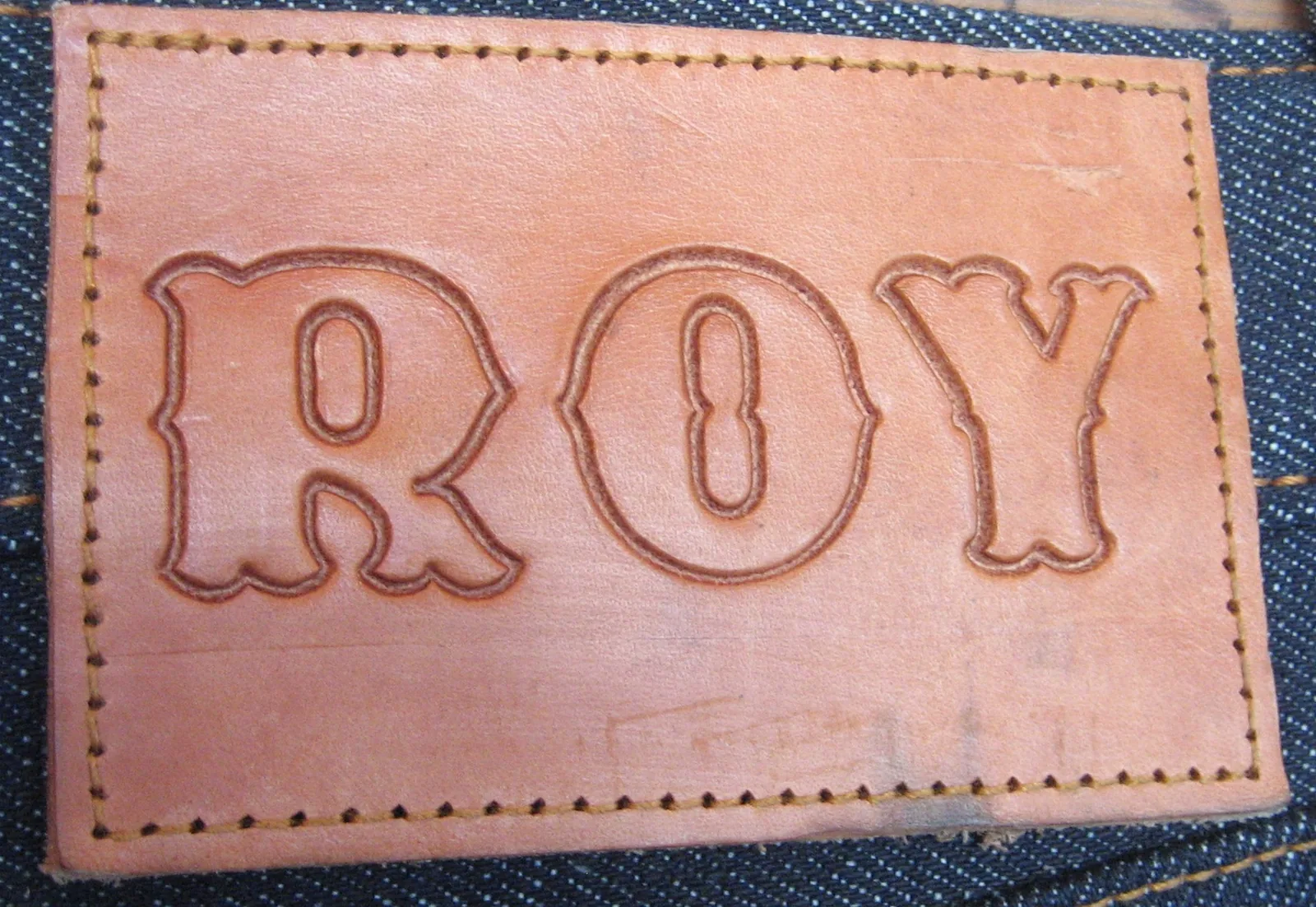
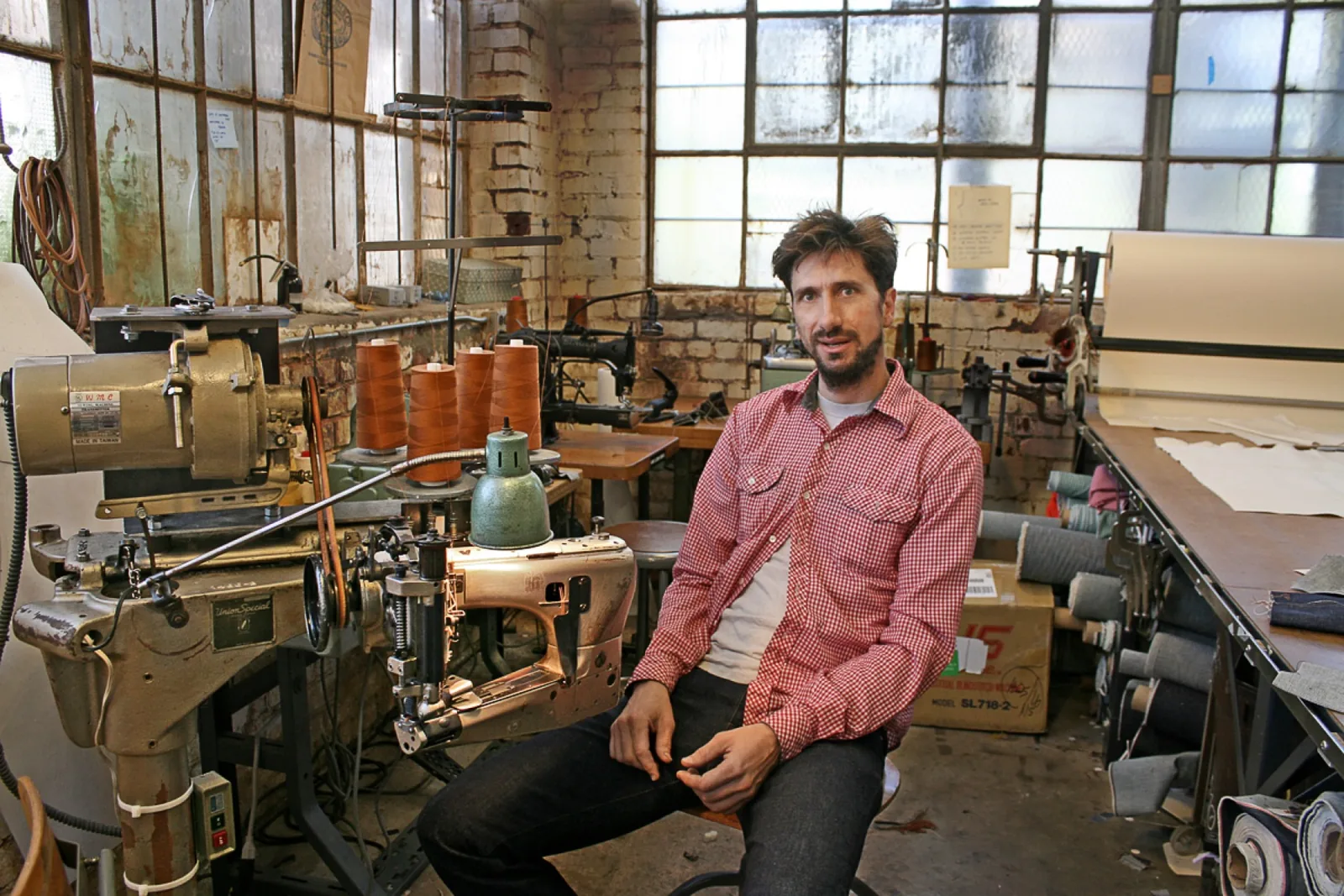
That background is why Roy could do that others could not. When a machine would not operate the way he wanted it to perform, he did not look for a different machine or design around the limitation. He modified the machine. His shop was a row of black heads with gold lettering, arranged in the order the work moved through them, each one tuned or altered for exactly one job — a belt loop machine, a bar tacker to anchor them, a keyhole buttonholer, a specialty overlock for edges, an embroidery head for the logo he drew himself. He built the tooling that produced it all.
He preferred old machines, and not for the reason you would assume. Not for the romance and authenticity of the old ways; he just thought they formed a better stitch. He got the advice early from a man named Billy at Apparel City: buy vintage, because the steel was better then. He decided Billy was right and never really revisited it.
To me, making clothing, designing, sewing and machine repair are all one subject. Getting a total basket case machine and fixing it, is right up there on the beauty scale. Second, maybe, only to finding it in the first place. Digging through some basement and finding one of my precious little heaps, that’s the most beautiful thing in the world.
Asked about his crafting in that same 2010 interview, he stopped to object to the term. Craft, he said, used to mean the culmination of years of practice and training, expressed and visible in the finished piece — something you either had accumulated or had not. He thought it had been reduced to glue guns and bad DIY, and he called it a “dead term to anyone doing quality, professional work.” He noted, with evident satisfaction, that Oxford had marked the word as archaic.
One of the most revered artisans in American denim did not want to be called an artisan. He wanted the work to be described accurately, which is a different and much harder request.
Let’s briefly look at what he actually made. He started making jeans in his apartment in 2007 and was selling them around 2010. Roughly 150 pieces per run, start to finish, every step his own: from patterns, cutting, sewing, finishing, and graphics. He was working at capacity in the realest sense: there were no more hours available in the day.
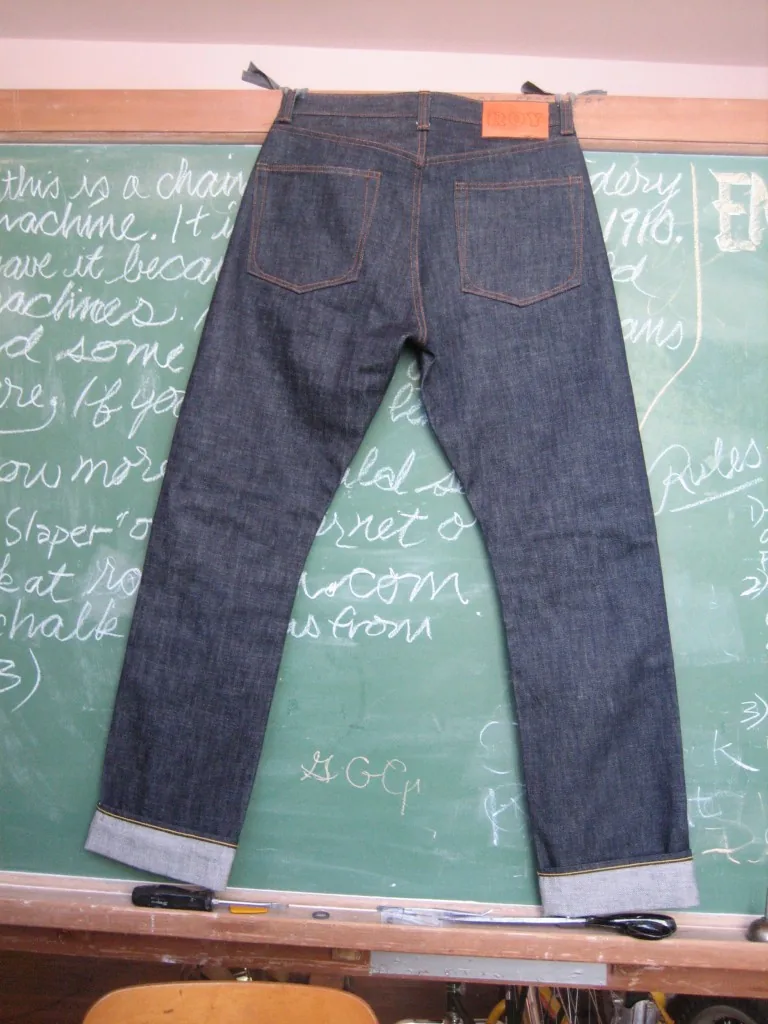
Roy was one of a very small number of individuals who ever persuaded Cone Mills’ White Oak plant to weave a collaborative fabric to his specification. That was Black Seed: a 13.5oz denim with a short-staple cotton warp and a Supima weft. It remains one of the most sought-after denims ever made in the USA, which is a sentence he would probably find faintly embarrassing.
He defended Cone Mills, at length and with some heat, against the reflex that Japanese denim was automatically the superior article. He argued that Cone was not trying to produce the same effects, not the slub, not the fast dramatic fade, but a more uniform cloth that developed character slowly and did not announce itself. Reading his description back now, it’s hard to miss that he is also describing his own work, and possibly himself: understated, never flashy, and full of decisions you only find if you go looking.
I never met him. I never owned a pair of ROY Denim. Kiya Babzani, one of the founders of Self Edge, knew him well. Self Edge carried Roy’s work, and the two of them worked together for over ten years, which in this trade is most of a career. Kiya’s tribute this week is the best short description of the man anyone is going to write, and it is not about his garments:
He was truly a one-of-a-kind human, the kind that kept digging even though he already knew enough; didn’t matter if it was vintage sewing machines, baseball stat facts, Oakland skate spots, or open water swimming. He went in deep, every time.
The kind of person that kept digging even though he already knew enough. Taken together with what he told Leafbox sixteen years earlier — “you’re hungry, and you eat” — and you have a complete picture of the man Roy was. Whatever that appetite was, it was not specific to denim.
Kiya also mentions his sense of humor, which he describes as unhinged in the best way possible, and which you can hear in the interviews if you know how to listen for it. Asked in 2010 which single machine he would take to a desert island, Roy said a treadle-powered single-needle lockstitch, because there would be no electricity, and then added that it would be handy because those castaways always get to looking so ratty.
Roy would not hire anyone. He went back and forth on it for years, and the reasons he gave were partly financial and logistical, which they always are, but the real one sat deeper: Roy Jeans was an embodiment of Roy. Every judgment call inside the garment was his judgment. Adding hands would have made it a different object, and he could not find a way to want that.
What he said he wanted instead came out in 2013, sounding like it had surprised him on the way up: apprentices. Not employees, but people willing to spend the years it would take to actually learn what he had learned, so the techniques would keep existing after him.
In 2021, he announced he had shut down ROY Denim. The market’s response to a maker stepping back was to bid up what he had already made. A decade of accumulated knowledge and technique walked out of the room with him, while his back catalog appreciated. In 2023, Roy took his remaining sewing machines and shipped them from his Oakland shop to Japan to set up a sewing studio at Buaisou Farm. He had also recently been working with Tilden Jeans, who have been using fabric made specifically for Roy for some of their current pieces.
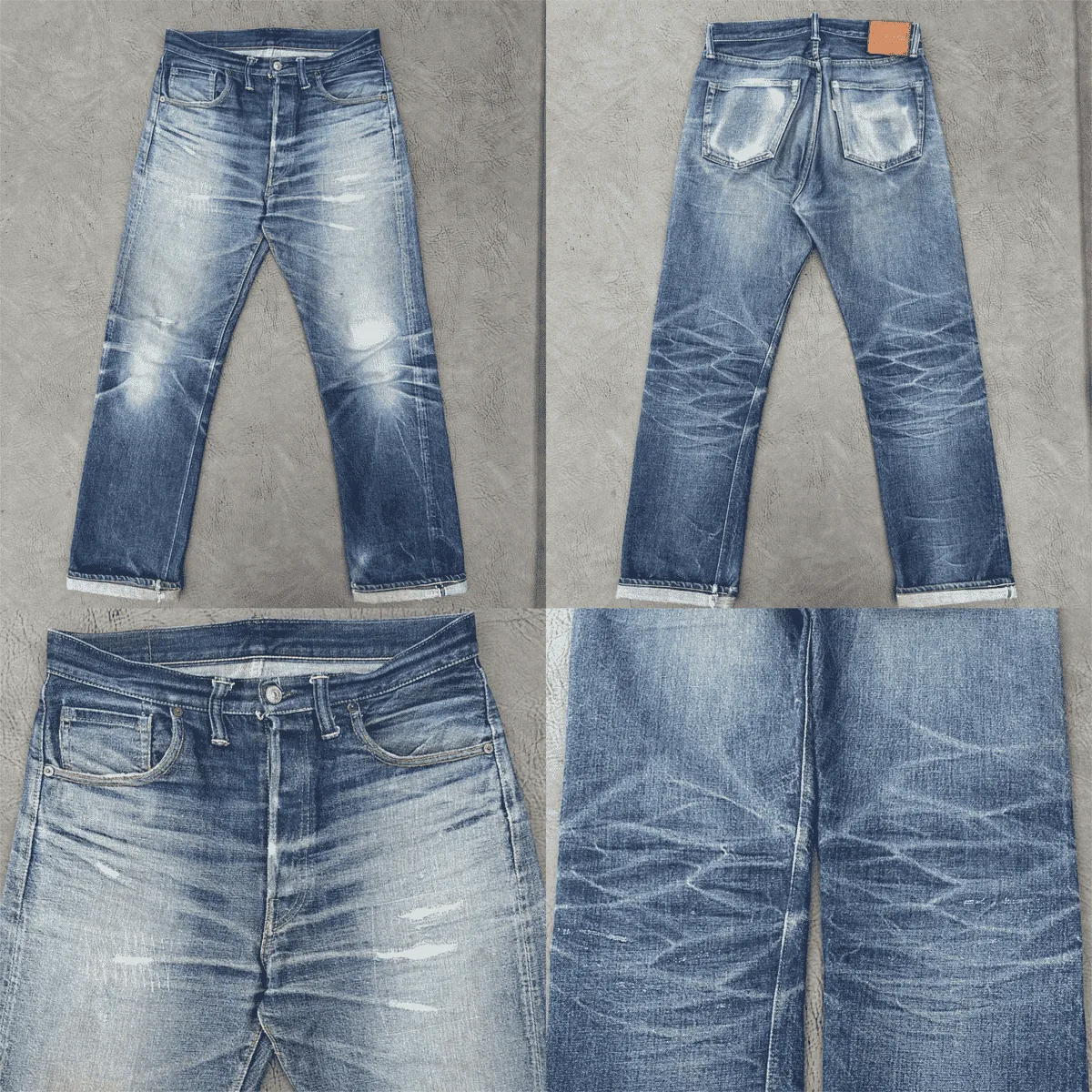
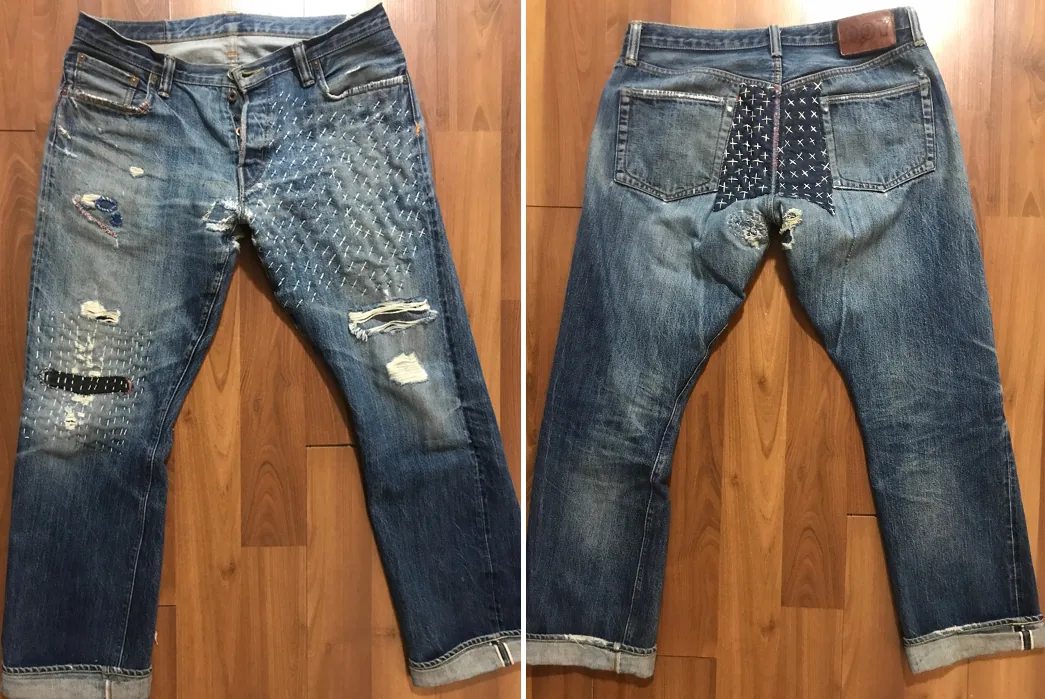
This past May, two months before he died, Heddels ran a fade feature on a pair of Roy’s RS1 straights. Fifteen years old, somewhere around twenty washes. Still in rotation, sashiko patches keeping a piece of history glued together.
Roy Slaper built things to outlive him, and they have. There are pairs of his in closets right now that will be here in another twenty years, going quietly on without him, exactly as designed.
If you own a pair, wear them.