The Champaran tenant was bound by law to plant three out of every twenty parts of his land with indigo for his landlord.
— Mohandas K. Gandhi, An Autobiography: The Story of My Experiments with Truth, Part V
In northern Bangladesh, there is a district called Nilphamari. The name comes from nil khamar, indigo farm, after the plantations the British ran there in the nineteenth century. Across the old Bengal delta, the brick shells of the indigo factories still stand in fields that now grow rice. People there call them nil kuthi.
On the island of Shikoku, Japan, a handful of farms still pile harvested indigo leaves into long, earthen-floored sheds and turn them, water them, and monitor their temperature for about a hundred days until they become a dark compost called sukumo.
In the South Carolina Lowcountry, the indigo that made the colony rich was planted, cut, steeped, beaten, and dried by people who were enslaved. Most of their names are gone. The name of the teenager who ran the plantation where the crop first succeeded is in every history of the subject.
The same blue molecule appears in all three places. What happened to the people who made it could hardly have been more different.
One Molecule, Many Plants
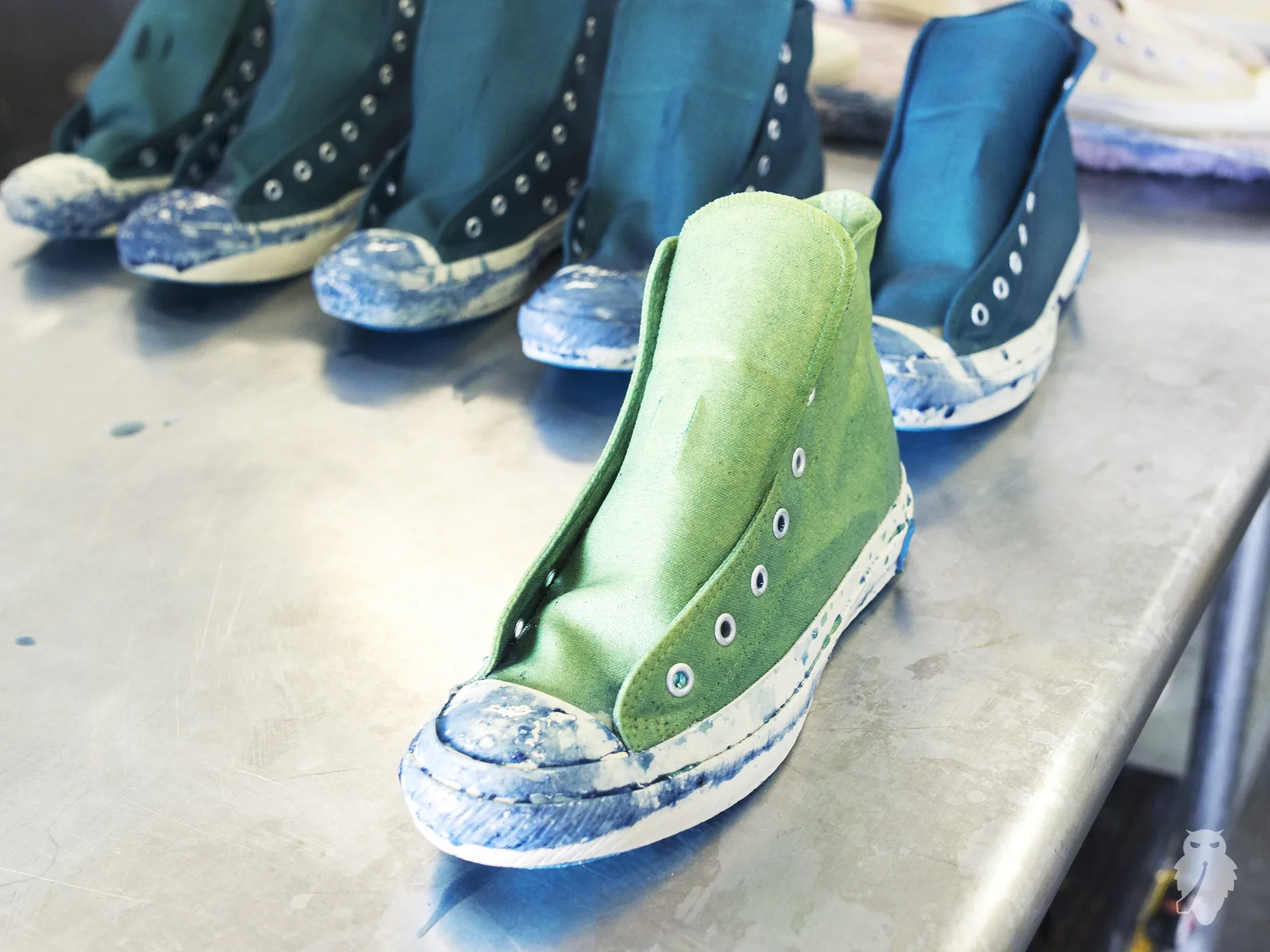
If you read Part One of this series, you already know the strange chemistry at the center of this story. Indigotin, the molecule behind every natural blue in this essay, is insoluble. If you put powdered indigo in a tub of water with a piece of cloth, nothing happens. The dye has to be reduced in an alkaline vat into leuco-indigo, a soluble yellow-green form that can soak into fiber. When the cloth comes out and meets the air, the molecule oxidizes back into blue and locks itself in place. As Part One put it: “Indigo never bonds to anything; it just gets trapped mechanically, mid-collapse from soluble to solid.”
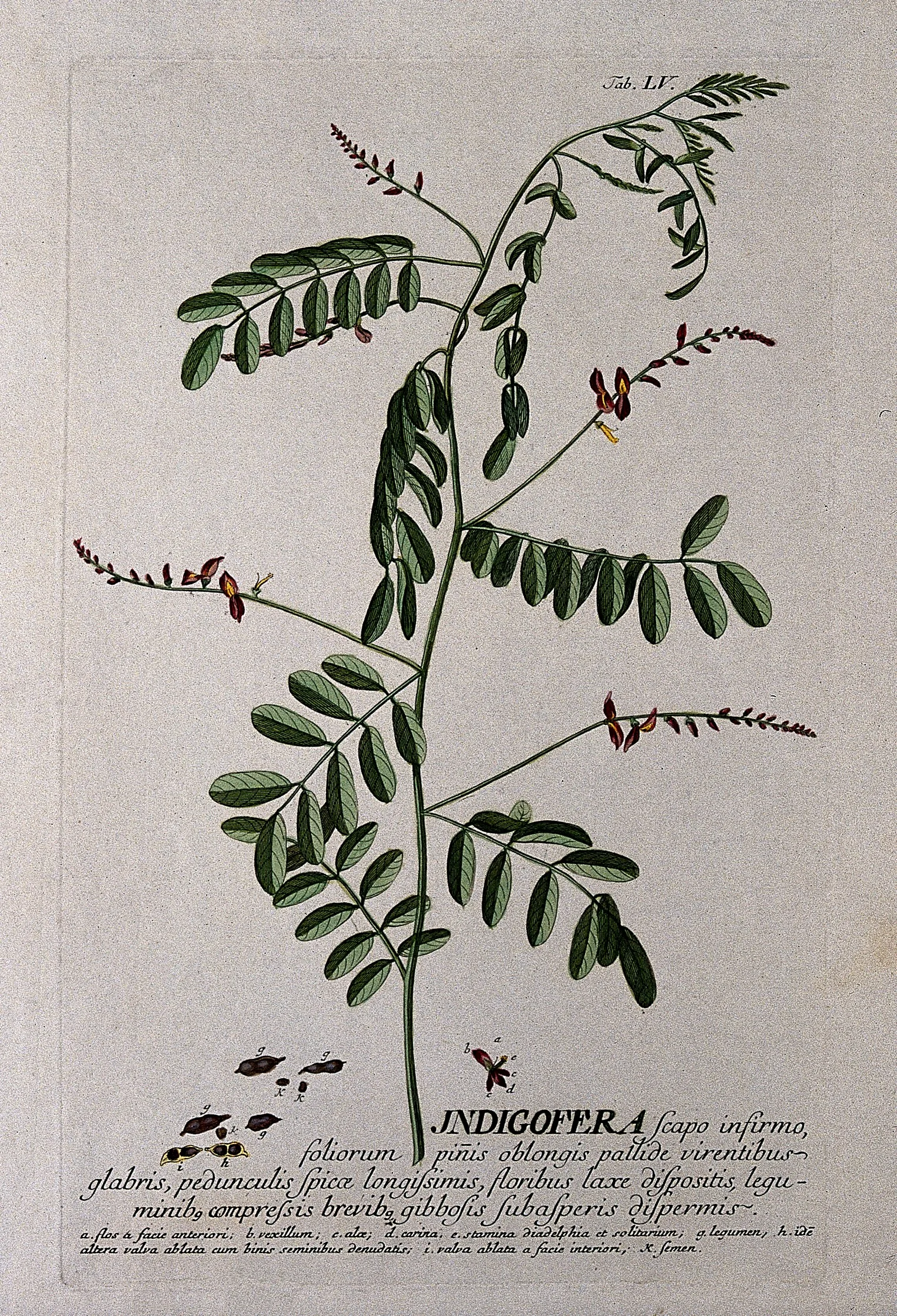
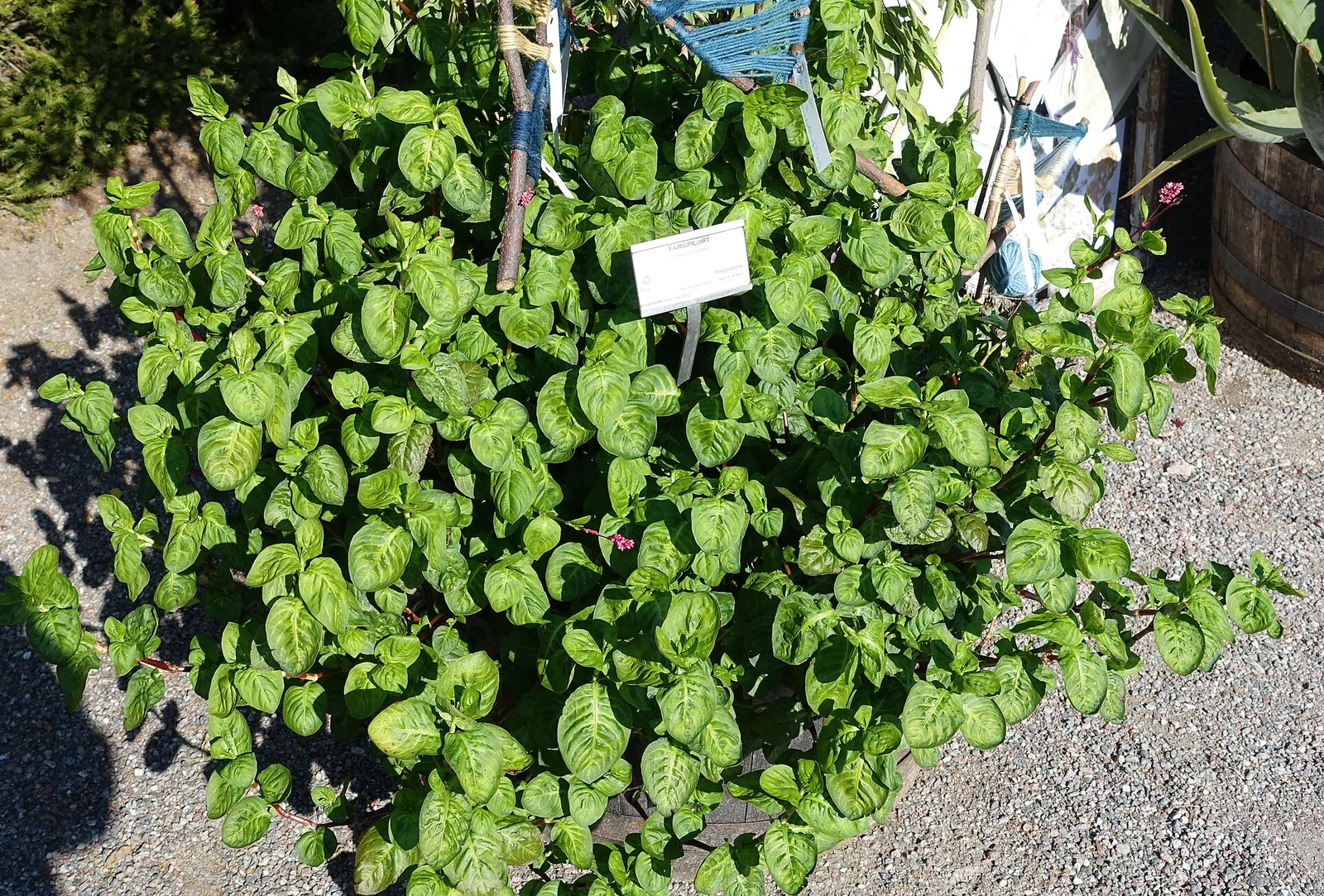
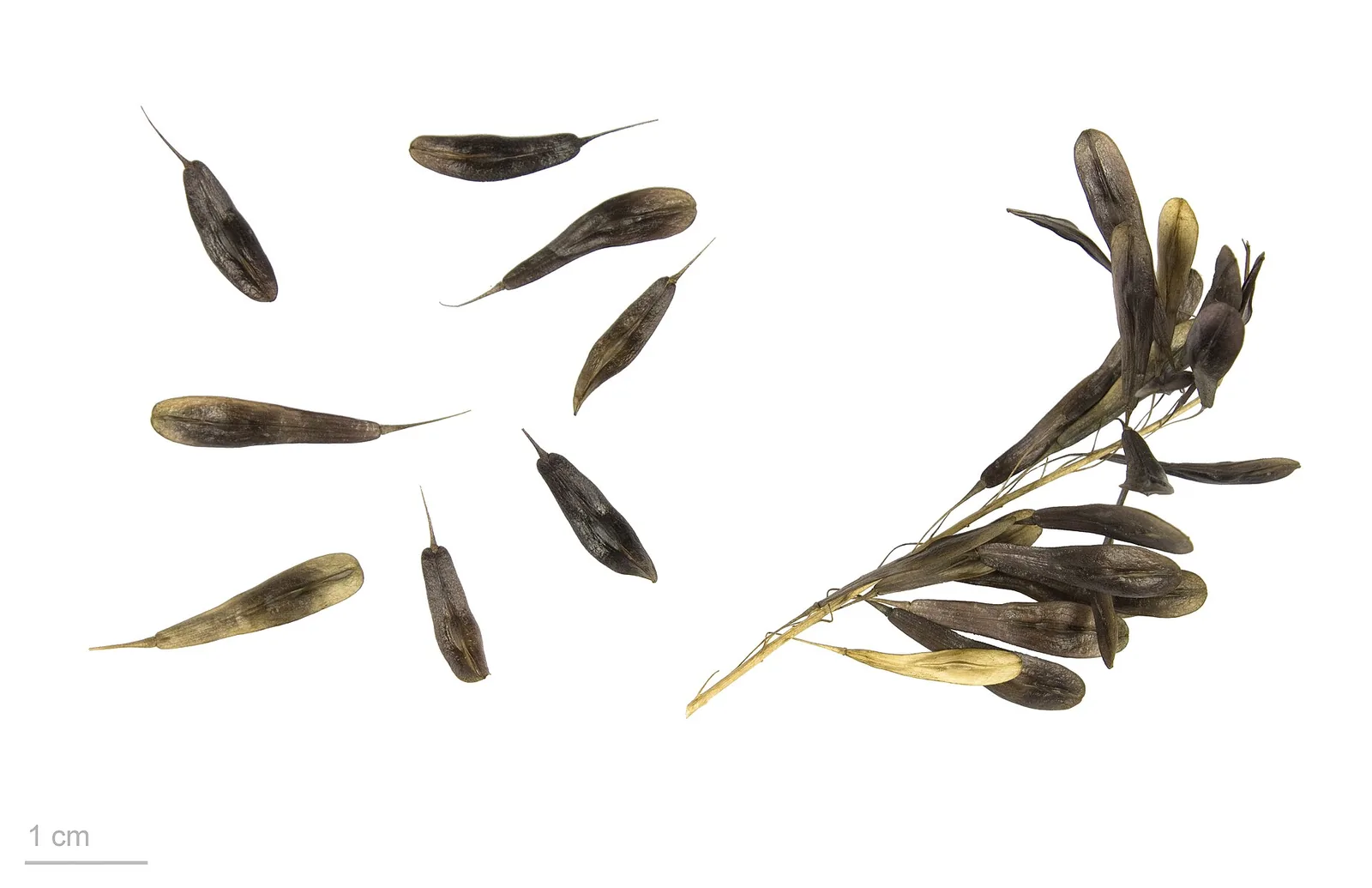
That molecule turns up in unrelated plants on several continents. South Asia had Indigofera tinctoria, a shrubby legume. Japan grew tade-ai (Persicaria tinctoria), a member of the knotweed family. West Africa used several local indigo-bearing plants, including Lonchocarpus cyanescens, a woody vine. The Caribbean and the Americas had Indigofera suffruticosa, the variety that would reach South Carolina. Europe had woad, Isatis tinctoria, a plant in the mustard family that yields the same blue in smaller amounts.
The Indian plant gave the color its name. Greek and Roman merchants bought the dye as a finished import, and the Latin indicum simply means “from India.” For most of its history, the blue came from somewhere else, and whoever controlled that somewhere else controlled one of the world’s most valuable commodities.
Before the Factories
The oldest trace of indigo has nothing to do with cloth. In Dzudzuana Cave, in the foothills of the Caucasus in Georgia, archaeologists examined river pebbles that people had used as grinding tools between 32,000 and 34,000 years ago. Tiny pits in five of those stones contained blue residues with indigotin and traces of woad. The people who used them were crushing woad leaves, and when the research team repeated the work with fresh leaves and a pebble, grinding alone was enough to release the blue.
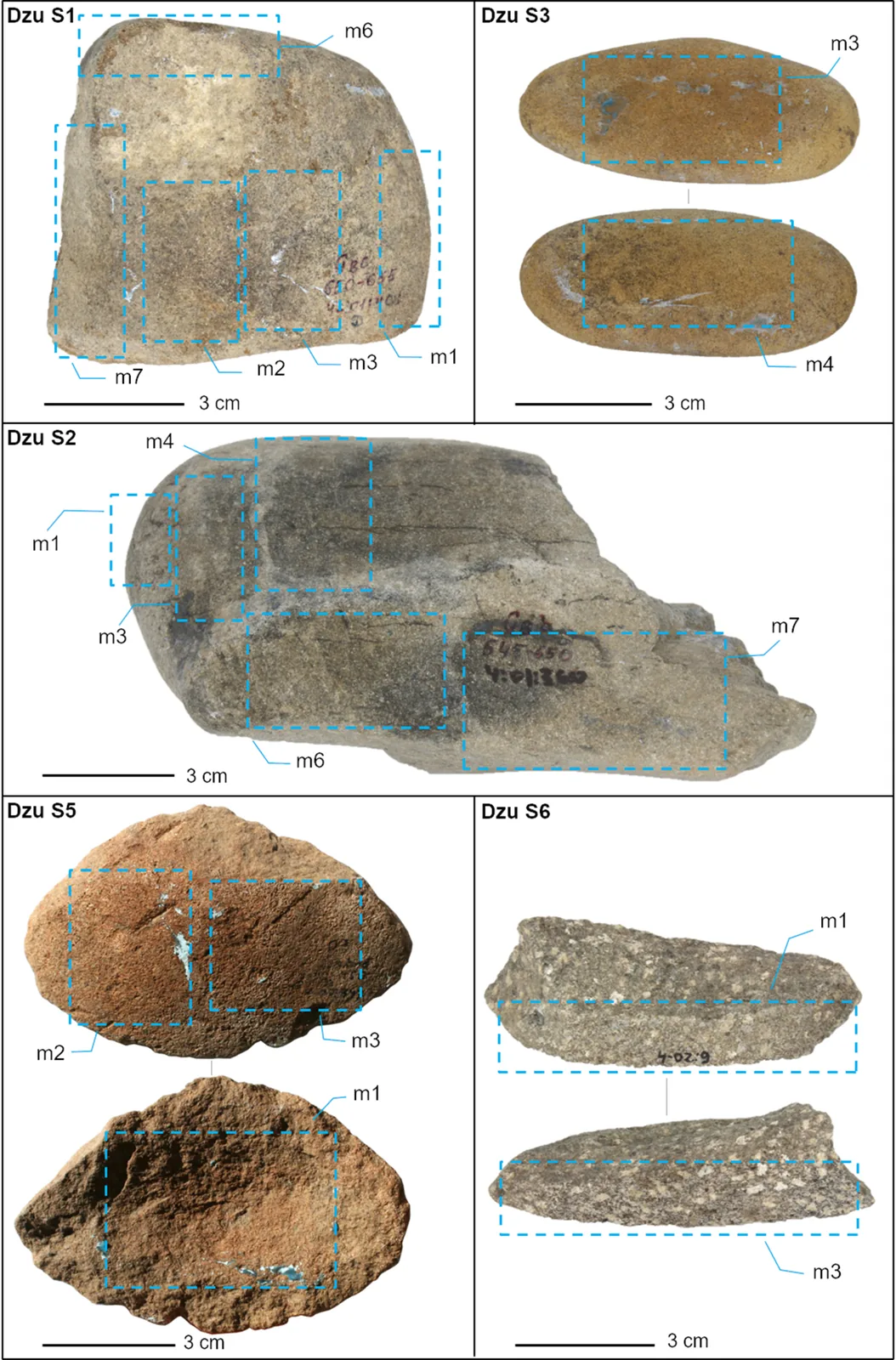
What they used the ground leaves for has yet to be determined. Woad leaves are too bitter to eat, so it was not food. The plant has a long history as a medicine, and modern studies credit it with anti-inflammatory and antimicrobial properties. The researchers cannot say whether the people of Dzudzuana used it as a remedy, a colorant, or both. Karen Hardy of the University of Glasgow, one of the authors, suggests it may have been valued as medicine first, with people only gradually coming to prize the color it left behind. Either way, someone, tens of thousands of years before the oldest indigo-dyed cloth yet found, understood that this plant was worth the labor.
The cloth first turned up in Peru. At Huaca Prieta, on the country’s north coast, archaeologists recovered fragments of twined cotton with stripes dyed blue roughly 6,000 years ago. Chemical testing confirmed indigo, most likely from a South American species of Indigofera. The team behind the 2016 study dated the find to about 1,500 years before the oldest indigo-dyed cloth known in the Old World.
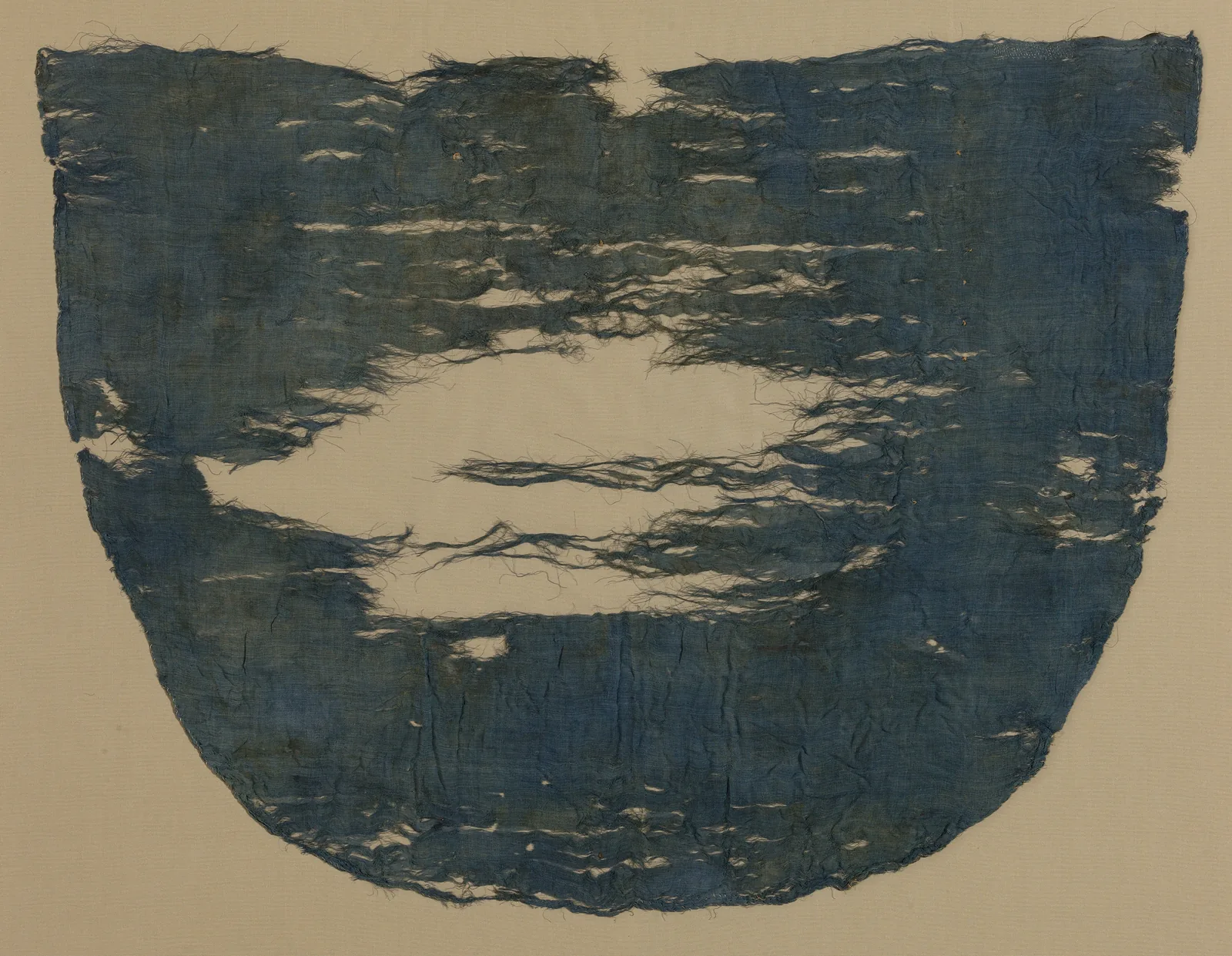
Egypt holds that Old World record. Histories of indigo say it colored Egyptian clothing as early as the Fifth Dynasty, around 2500 BCE, and later mummy wrappings, a claim that dates to a 1956 survey by historian R. J. Forbes. Where Egyptian blues have been tested, the dye found is indigotin, but what can’t be settled is which plant it came from. As Oxford’s Ashmolean Museum points out, a dye test identifies the molecule, not its source, so an ancient Egyptian blue could have come from woad as easily as from Indian indigo, which isn’t clearly documented in the Mediterranean until Hellenistic times. The best-documented early example is small. Among the leftover linens from Tutankhamun’s embalming, around 1325 BCE, is a child-sized kerchief that the Metropolitan Museum of Art identifies as linen dyed with indigotin.
The Romans knew indigo as an expensive import but did not understand it. Pliny the Elder, writing in the first century CE, described indicum as “a slime which adheres to the scum upon the reeds” of India, black as a powder but yielding “a marvellous combination of purple and cæruleum” in water. Dealers faked it by staining pigeon dung with a little real indigo, or chalk with woad. Buyers tested it on hot coals, where the genuine article gave off a purple flame and a smell like seawater, which led some to believe it was gathered from rocks on the shore. It cost twenty denarii a pound. Elsewhere, Pliny mentions an “Indian” blue that painters used to separate shadow from light, though scholars still debate whether it was the same substance. A Greek merchant’s guide from the same century, the Periplus of the Erythraean Sea, lists indigo among the goods shipped from Barbarikon, a port at the mouth of the Indus.
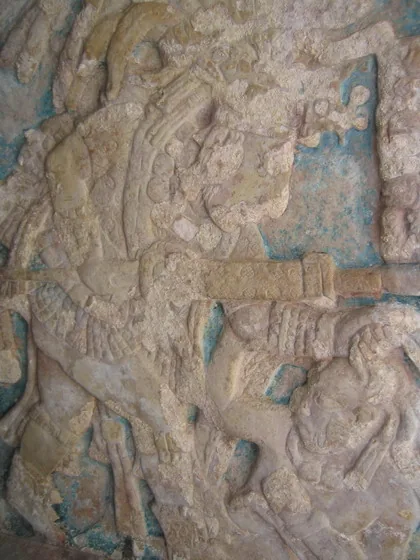
On the other side of the Atlantic, the Maya used indigo in a way no one else did. By heating it with a pale clay called palygorskite, they made Maya blue, a pigment durable enough to survive centuries on murals and carvings, in use from about 300 to 1500 CE. At Chichén Itzá, victims sacrificed to the rain god Chaak were painted blue before they were thrown into the Sacred Cenote, a natural sinkhole, and the pigment that washed off them settled into a blue layer at the bottom of the well. A bowl dredged from the cenote in the early 1900s still held traces of indigo, clay, and copal incense, suggesting the blue may have been made during the ritual itself by burning them together.
In the Old World, indigo traveled the trade routes as a luxury. A document from the Cairo Geniza, the storeroom of a medieval synagogue in Fustat, records that in 1098 an Indian trader named Joseph Lebdi owed forty dinars for indigo. Two centuries later, Marco Polo described indigo making at Quilon, now Kollam, on India’s southwest coast. The plant was cut, he wrote, and put “into great vessels upon which they pour water and then leave it till the whole of the plant is decomposed,” and the liquid was set in the sun until it “boils and coagulates.” Polo credited the sun’s heat, but what he was actually watching was the process of fermentation.
By the 1600s, European companies were buying indigo directly in Mughal India. On November 1, 1610, William Finch, an agent of the English East India Company, was sent to Biana, near Agra, “to buy nill, or indigo.” Good indigo, he wrote, needed “a pure grain, a violet colour, a gloss in the sun, and that it be dry and light.” Two months later he left Agra with “twelve carts laden with indigo, in hopes of a good price.” The French traveler Jean-Baptiste Tavernier described the workers who sifted the dried dye for export. They covered their faces and drank milk every hour, and still, after eight or ten days at the job, everything they coughed up came out blue. An egg left near one of the sifters in the morning, he wrote, was “altogether blue inside” by evening.
The last great supplier before Bengal was in the Caribbean. French planters built indigo works across their islands in the late 1600s, 48 of them by 1683. By 1713, Saint-Domingue, now Haiti, had 1,200, and by 1730 it had twice that, making it Europe’s main source of indigo in the eighteenth century. The historian Jutta Wimmler ties that growth directly to the slave trade, which forced ever more people across the Atlantic to work the plantations and the vats. Britain had been buying indigo from those French islands until war intervened. When King George’s War cut off that supply in the 1740s, Britain began looking for blue it could grow within its own empire. It found it in South Carolina.
↑ Table of ContentsWoad and the Devil’s Dye
Woad is a tall plant in the mustard family that spends its first year as a low rosette of leaves and its second sending up a head of small yellow flowers. The blue is in the leaves, in far smaller amounts than in tropical indigo, and getting it out was heavy work. In England, workers crushed the fresh leaves under large wheels, kneaded the pulp into balls by hand, and dried the balls on open racks. They broke up the dried balls, spread them across a floor, wetted them, and left them to ferment for weeks — a stage called couching that was notorious for its smell. The workers, known as waddies, followed the crop from field to field with mills they could take down and move, because woad wears out soil quickly.
Europeans dyed with woad long before there was any documentation of the process. Textiles preserved by the salt in the mines at Hallstatt, in Austria, carry woad blue from the Bronze Age and the early Iron Age. Julius Caesar wrote that the Britons “dye themselves with vitrum,” which made them blue.
By the late Middle Ages, woad made people rich. In Thuringia, the woad trade around Erfurt produced a merchant class wealthy enough to help found the University of Erfurt in 1392. In southern France, woad made the country between Toulouse, Albi, and Carcassonne so prosperous that the region still calls it le pays de Cocagne, the land of plenty, after the balls of crushed woad leaves (cocagnes) that merchants dried and sold. Toulouse’s woad merchants built Renaissance townhouses that still stand, among them the Hôtel d’Assézat, begun in 1555. Woad sat alongside weld and madder as one of the three staple dyes of medieval Europe, as we discussed in Part Six.
Woad was profitable enough to alarm the English queen. In October 1585, Elizabeth I issued a proclamation against the sowing of woad. Landowners had been plowing up “very fertile grounds” for the crop to pursue “private and inordinate gain,” at the expense of grain, dairies, and the cloth trade. The proclamation banned woad fields within four miles of any city, market town, or clothing town, and within eight miles of any of the queen’s houses. Anyone who broke the order, along with the laborers who worked the ground, was to be jailed.
Once Portuguese and Dutch ships began bringing Indian indigo into European ports in serious quantity, woad could not compete. Its growers and merchants fought back through law. In 1577 the Imperial Diet banned the “newly-invented pernicious, deceitful, eating, and corrosive dye called the devil’s dye,” made with vitriol instead of woad, and complained that cloth dyed with it was eaten through within a few years. The ban was repeated in 1594 and 1603. The act never names indigo directly, but historians have long read it as aimed at the new dye. France followed with its own restrictions, reportedly lasting until 1737.
Woad lost the fight slowly, and in England it outlasted the bans by centuries. The last portable woad mill, at Parson Drove in Cambridgeshire, was demolished in 1914, and the last permanent mill, at Skirbeck in Lincolnshire, closed in 1932.
The bans protected the woad trade, but the complaints were not all invented. Vitriol, crystals of iron sulfate, was added to the vat to strip oxygen from indigo so it would dissolve. Iron left behind in the fibers can slowly break them down, which is why so many iron-dyed black textiles in museum collections have crumbled. Part Seven traced a similar fight over logwood, which England banned as a fraudulent dye in 1581 after dyers used it to fake costlier colors. None of these laws held for long. The demand for cheaper, stronger blue had to be met somewhere. For Britain, that somewhere would be its own colonies.
↑ Table of ContentsWest Africa: The Blue Before the Crossing
The American chapter of this story is usually told as if indigo arrived in Carolina as a seed packet from the Caribbean. The knowledge of what to do with it had a longer road, and much of it ran through West Africa.
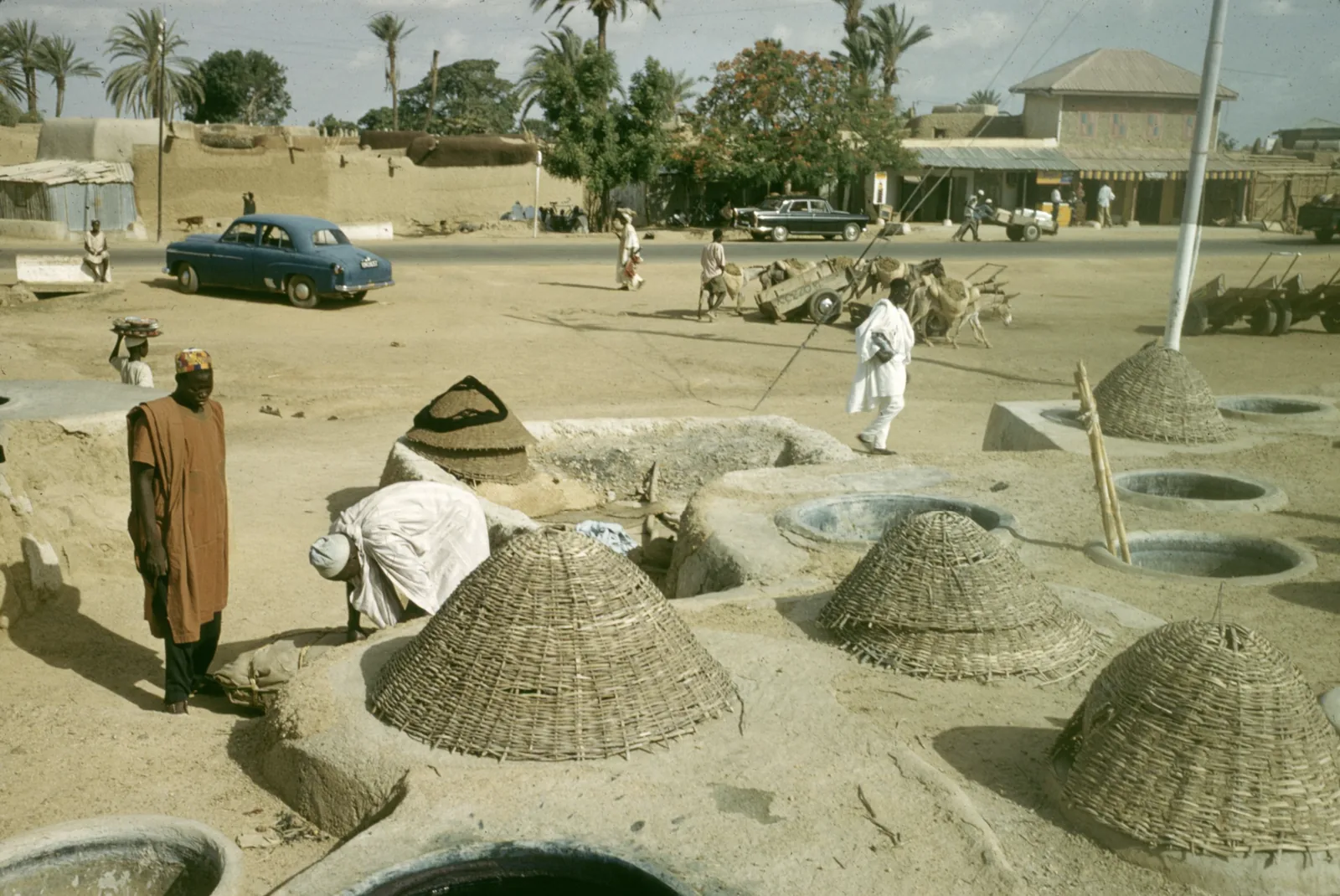
Indigo dyeing in West Africa is old and was already a trade long before any European ship arrived. In Kano, in what is now northern Nigeria, the Kofar Mata dye pits have been worked since at least the end of the fifteenth century. The sign at the gate states 1498. Some accounts push the site’s history earlier still. The pits are deep, narrow wells dug into the ground and lined to hold a fermenting indigo vat. The dyers use three ingredients: indigo plant material, wood ash, and potash. Cloth goes down into the pit, comes up yellow-green, and turns blue in the air, the same chemistry as the others in a very different vessel. Kano’s dyed cloth traveled the Sahel’s trade routes, and the pits helped make the city one of the region’s richest. Many have been abandoned, but dyers still work some of them.
Farther north, Tuareg men wore the tagelmust, a veil and turban of indigo-dyed cotton that can run ten meters long. In the desert, where water was scarce, some finished that cloth by pounding powdered indigo into it rather than soaking it. The color never fully fixed, and it rubbed off onto the skin of the people who wore it, which is where the name “the blue men of the desert” comes from. It is the crocking problem described in A Tale of Two Fibers, turned into a mark of status.
On the Atlantic coast, dyers in Senegambia, Sierra Leone, and the Gold Coast practiced indigo dyeing as a skilled craft, passed down from generation to generation. Most of the Africans enslaved and shipped to the Carolina Lowcountry were taken from those regions and from West Central Africa, and indigo planters were said to prefer people taken from Senegambia. Historians such as Judith Carney have documented how enslaved West Africans brought rice expertise to Carolina and how planters depended on it. The case for indigo is harder to prove in the documents because the documents were written by the people who profited. Still, the knowledge existed on the African side of the Atlantic, and the people who carried it were in the Carolina fields.
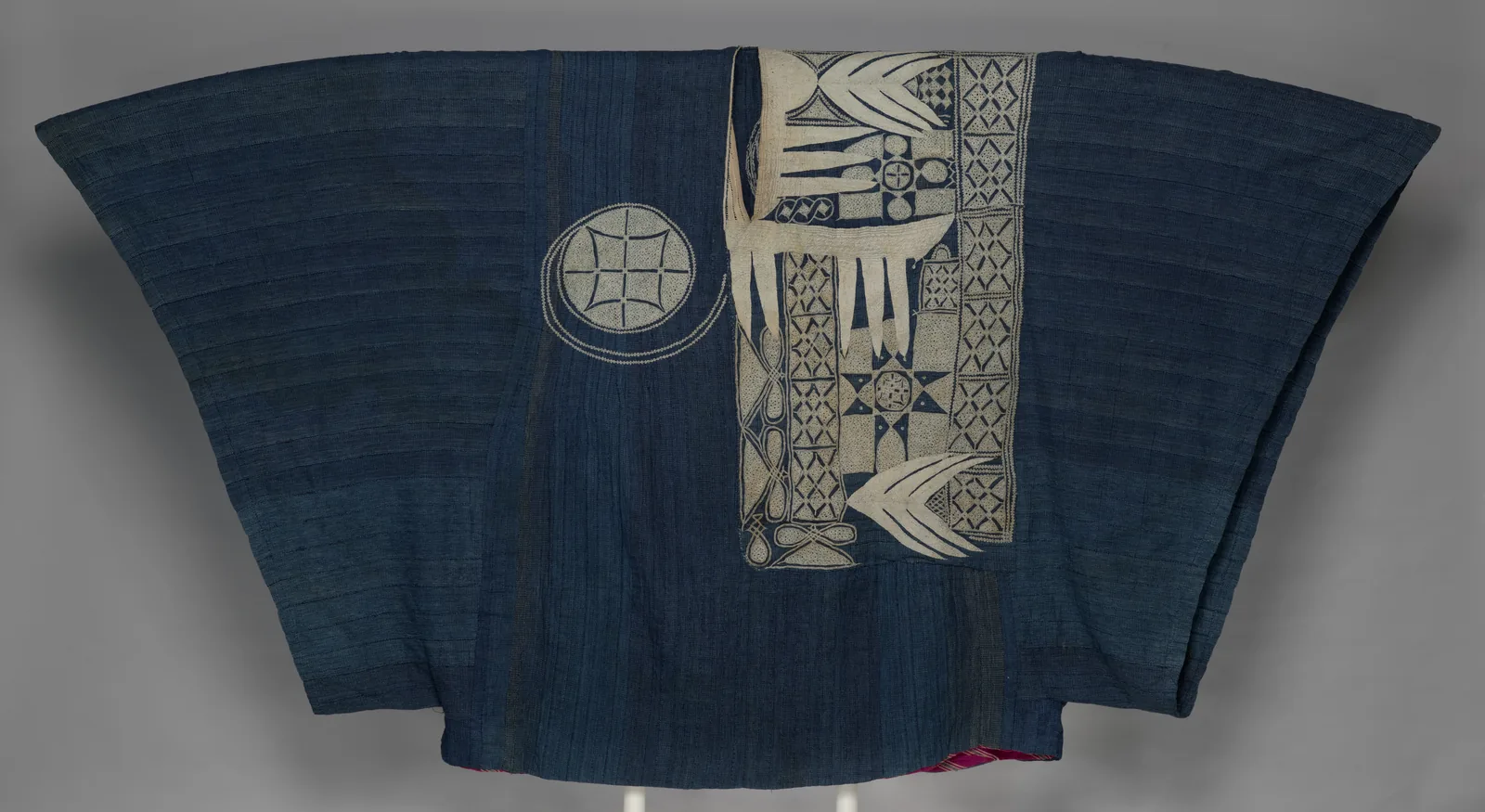
West African indigo did not stop at the coast or with the trade. In Yorubaland, in the early twentieth century, women dyers in Abeokuta and Ibadan built adire into a regional industry. In adire eleko, designs are painted onto cloth with a cassava-starch paste that resists the dye; then the cloth goes into the indigo. Women controlled the whole business: design, dyeing, and sales. It reminds us that the dye’s West African history is not only the history of what was taken from it.
South Carolina: Blue Built on Bondage
In 1738, George Lucas, a British army officer, moved his family from Antigua to South Carolina. A year later, he was recalled to the Caribbean, and his sixteen-year-old daughter, Eliza, was left to run three plantations. At Wappoo, where she lived, she managed the labor of about twenty enslaved people.
Carolina already had a cash crop. Rice, grown in the tidal swamps, made the Lowcountry rich, and it did so on the labor and often the knowledge of enslaved West Africans, many of whom came from rice-growing regions and understood the crop better than the people who owned them. Planters wanted a second export. Indigo grew on higher, drier ground than rice, so planters could add it without giving up rice land, and the same enslaved workforce could work both crops.
Beginning in 1739, with seed her father sent from the West Indies, Eliza Lucas directed a series of indigo experiments at Wappoo. The enslaved people on the plantation planted and tended those experiments. Growing the plant was easy. Turning it into dye was much harder.
Her father sent an indigo maker from Montserrat to supervise. According to the story preserved in Lucas family accounts, he added too much lime and ruined the batch on purpose to protect Montserrat’s own indigo trade from a new competitor. They dismissed him and replaced him with his brother. The episode is usually told as a story about one young woman’s persistence, but it always leaves out who stood in those vats.
One of the people it leaves out has a name. Quash, a carpenter enslaved at Wappoo, was most likely born in South Carolina in the early 1720s. In December 1744, as the crop began to succeed, George Lucas wrote from Antigua asking that “Quashe may be put immediately to make an Indigo Work, of the same Dimentions with the Brick one at Wappo” at another family plantation. Quash spent more than a month building wooden indigo vats across the Lucas plantations. He was baptized in 1746 and took the name John Williams; in 1750, Charles and Eliza Lucas Pinckney freed him. He later directed the woodwork on the Pinckney mansion in Charleston as a master carpenter. Most of the people who worked those vats, deciding how long to soak the plants, how long to beat the liquid, and how much lime to add, go unnamed in the surviving records.
By 1744, the experiments had produced a usable dye. Lucas and her husband, Charles Pinckney, shared seed with neighboring planters, and the crop spread. The colony offered its own bounty of one shilling per pound in 1744. In 1748, Parliament made it a sure thing, passing a bounty of sixpence sterling for every pound of indigo shipped from its American colonies, paid from 1749, so Britain could buy blue from its own subjects instead of from the French Caribbean. In 1747, Carolina shipped 138,300 pounds of indigo to England. By 1775, the colony exported more than a million pounds a year, second only to rice. Indigo cakes were sometimes called blue gold and served as currency, including for purchasing enslaved people. The crop paid for its own workforce.
The work itself followed a fixed sequence, and every step ran on enslaved labor. The indigo was cut in summer and packed into a large wooden vat called a steeper, weighted down under water, and left to ferment. Workers drained the liquid into a second vat, the battery, where they beat it with paddles or bottomless buckets for hours to drive air into it. Lime water, made from burnt oyster shells, went in to settle the blue out of solution. Workers scooped the sludge into cloth bags to drain, spread it to dry in sheds, and cut it into small cubes before it fully hardened.
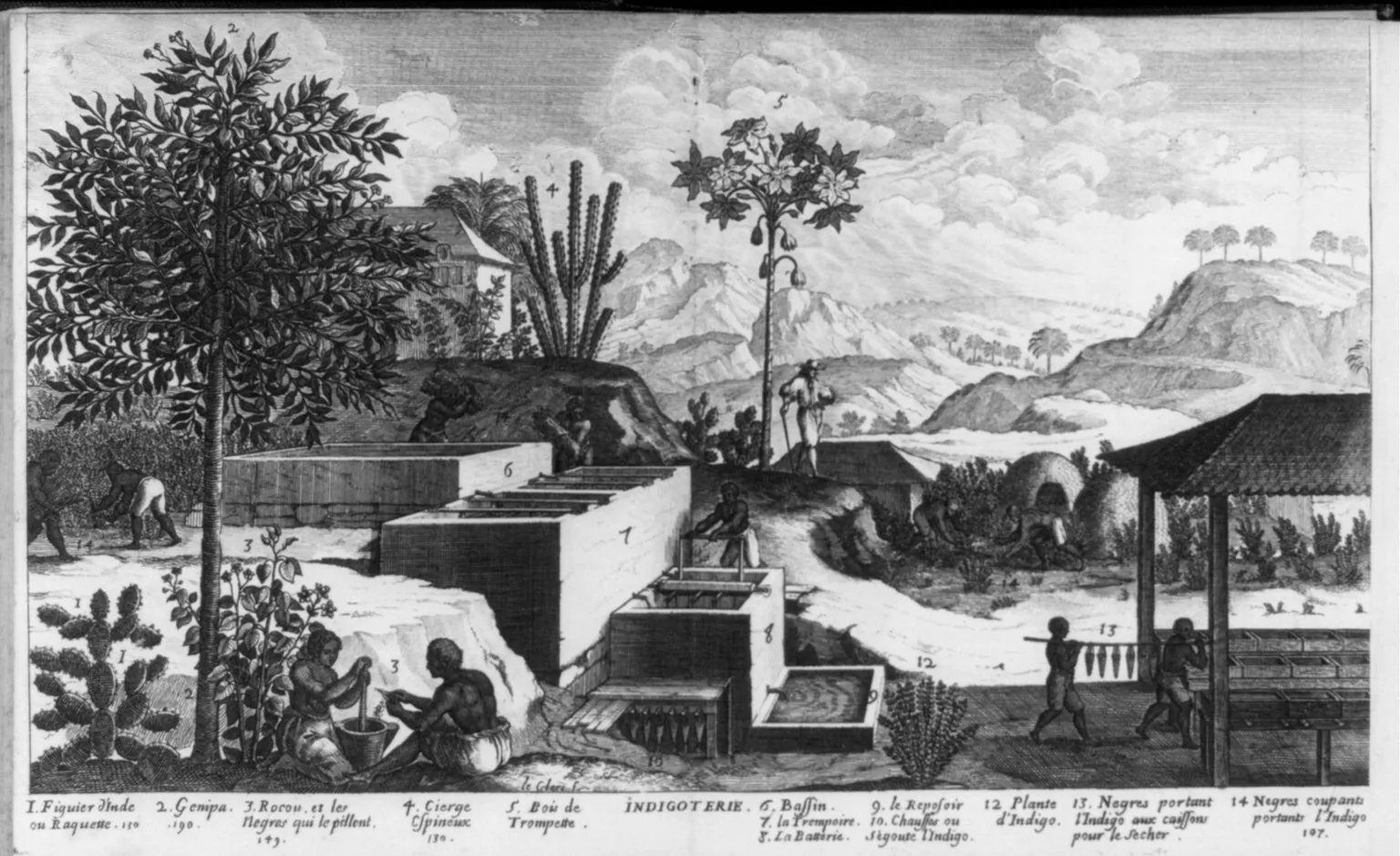
Every step depended on judgment. How long to steep, how long to beat, and how much lime to add determined whether a season’s crop became top-grade dye or waste, the same variables the saboteur from Montserrat had used against Lucas. The enslaved workers who made those calls were doing skilled work that could only be learned through long experience, and planters knew it. Writing in The Gentleman’s Magazine in 1755, Charles Woodmason, a South Carolina planter who later became an Anglican minister, reckoned fifteen enslaved workers to cultivate fifty acres of indigo and twenty-five “very able” hands to process it.
The workers paid for that crop with their health. Indigo was cut in July and again in late summer and processed on the spot in the worst of the heat, beside vats of fermenting leaves that stank of rot and drew swarms of flies. On plantations that also grew rice, the indigo work was added to the rice season, so the same people carried both. The planters grew rich, and the records they kept list the people who made them rich mostly as property, counted in hands per acre.
The American Revolution ended the arrangement. The British bounty lapsed in 1777 as independence took Carolina out of the empire that had paid it, and Britain turned to Bengal for its blue. Carolina planters kept growing indigo for a while without the subsidy, but by the early 1790s a glut on the world market had ended its profitability.
↑ Table of ContentsAfter Indigo: Cotton, Gullah Geechee, and Haint Blue
The end of Carolina indigo did not end anything for the people who had grown it. Improvements to the cotton gin in the early 1790s made upland cotton profitable, and planters moved their enslaved workforce onto the new crop. Cotton would demand far more enslaved labor than indigo ever had, and it would spread slavery across the Deep South.
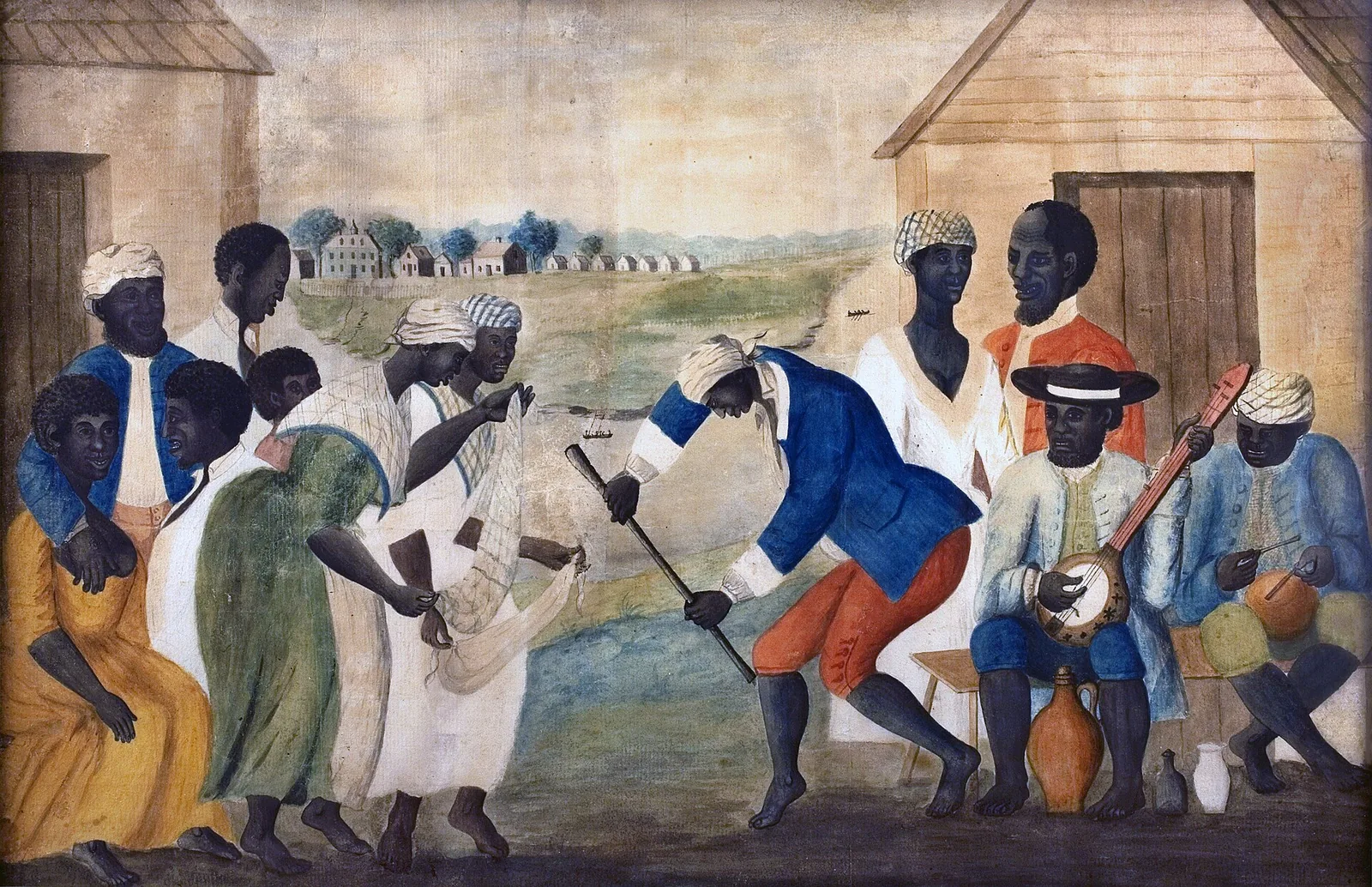
The descendants of the West and Central Africans forced to work the Lowcountry’s rice, indigo, and cotton plantations became the Gullah Geechee people of the Sea Islands and coast of the Carolinas, Georgia, and Florida. Their language, foodways, and crafts carry more of West Africa than almost anywhere else in the United States, and their memory of indigo runs deep.
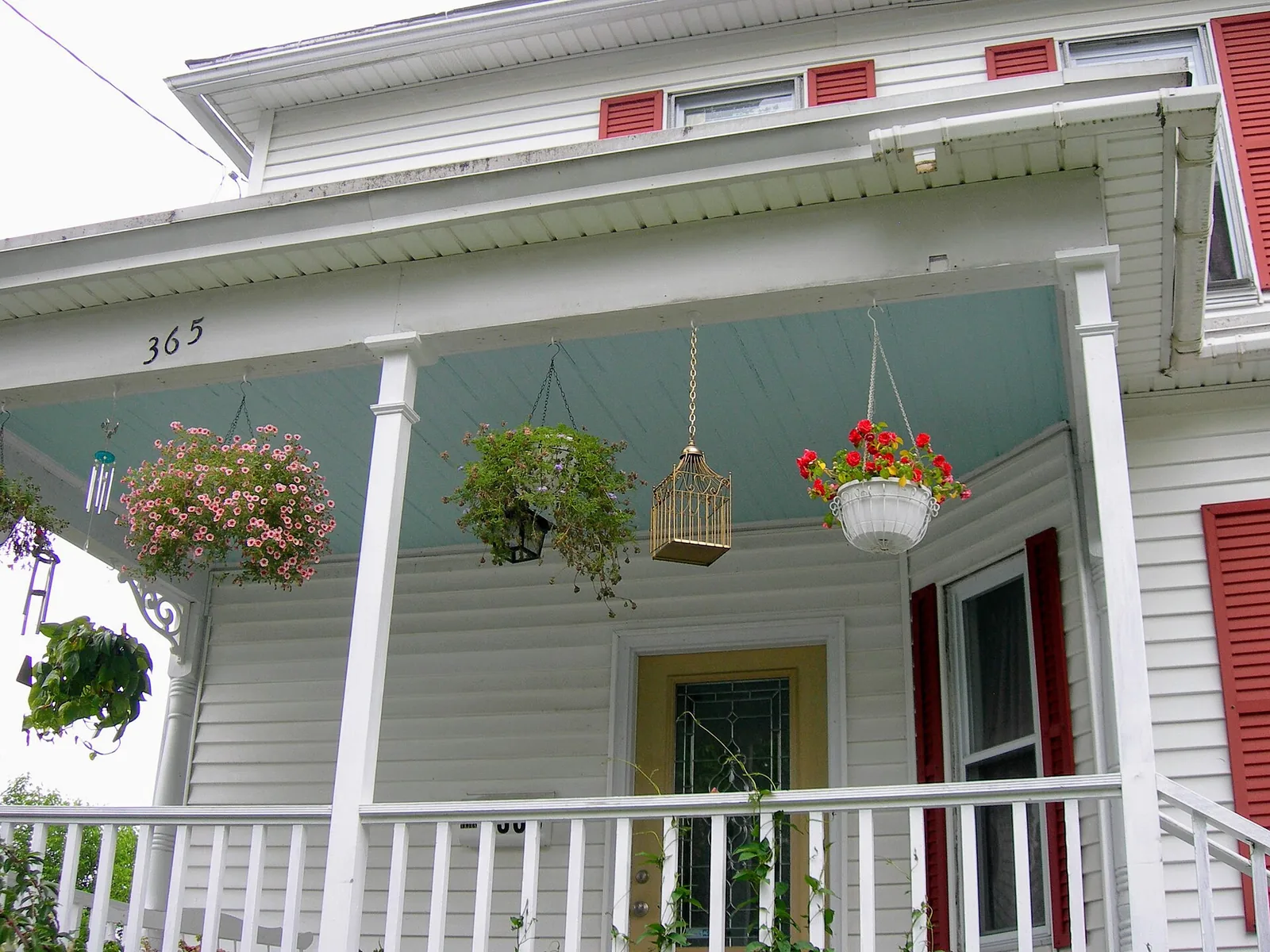
The most visible piece of that history may be haint blue. Most historians attribute the tradition of painting porch ceilings, doors, and window frames blue to Gullah Geechee communities, who mixed indigo with lime, milk, and other pigments to keep away haints, the restless spirits of the dead. The color suggested water, which spirits could not cross, or sky, which fooled them into passing through. Haint blue porch ceilings are all over the South today, usually made with commercial paint by people who have no idea what the custom means.
A group of growers and artists has brought indigo back to the Lowcountry. In Adams Run, south of Charleston, Sheena Myers grows it on a half-acre plot and has said, “A lot of people don’t even realize that it’s an African American crop.” Her work treats the plant as inheritance, not nostalgia.
On St. Helena Island, home of the Penn Center and a stronghold of Gullah Geechee culture, the textile artist Arianne King Comer founded the Ibile Indigo House after studying indigo batik in Osogbo, Nigeria. She taught hundreds of students the West African way of dyeing. She has since learned to grow the plant itself from descendants of the formerly enslaved. “Everything that I’m doing is coming from the land,” she has said. “I’m growing it, I’m processing it, I’m honoring ancestry.”
↑ Table of ContentsBengal: The Factory System
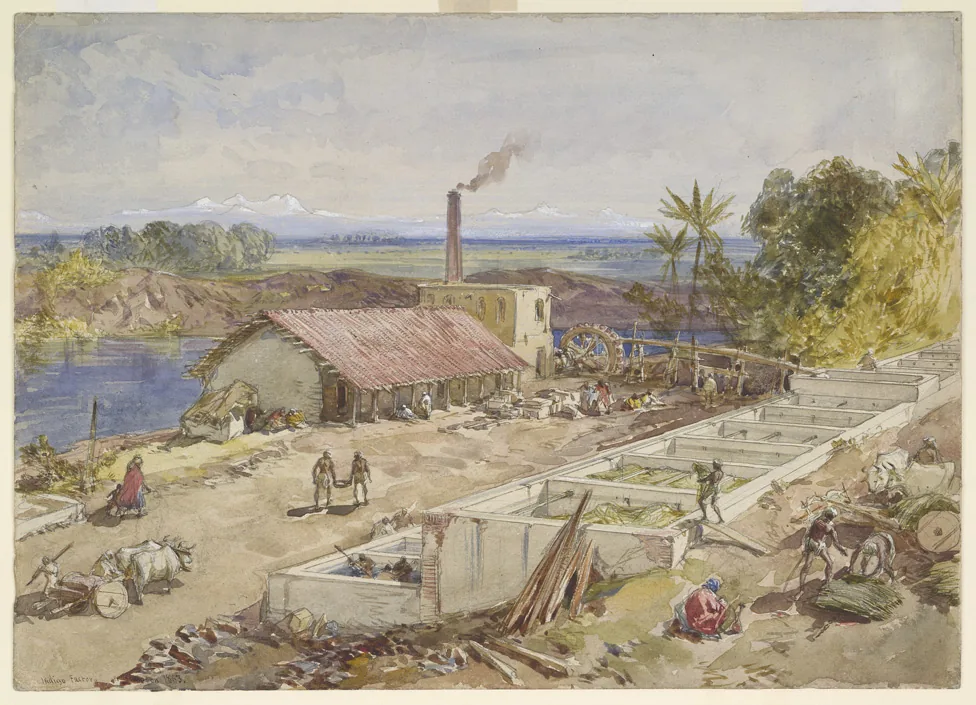
While Carolina’s indigo was dying, Britain’s next source was already taking root on the other side of the world. In 1777, a Frenchman named Louis Bonnaud began commercial indigo cultivation in Bengal near Hooghly. The East India Company saw an opportunity to supply Britain with a dye it would otherwise have to buy from rival empires, particularly after the American Revolution cut Britain off from Carolina indigo. It encouraged European planters to expand. The planters built nil kuthis, indigo factories, across the delta. The planters called their production “factories”, and the arrangement that grew around them is still called the factory system.
Planters ran it two ways. The first was nij cultivation, under which they farmed land directly with hired laborers. Far more common was raiyati cultivation, which worked through the peasant farmers, or ryots, on their own land. A planter advanced a ryot a small cash loan called dadon. In exchange, the ryot signed a contract to grow indigo on a set share of his fields and sell the crop to the factory at a price the factory fixed. The price was always below what the indigo was worth, so the harvest never covered the advance, and the loan rolled forward into the next season and the one after that. It was debt bondage that could never be escaped.
The contract was the least of it. The factory’s own agents measured each ryot’s land and weighed his harvest, and they kept the only accounts, which the ryot had no way to check. The factory also decided which fields went to indigo, and it usually picked the best ones, the land a family needed for rice. A ryot who planted food there risked losing the crop and the field. The Charter Act of 1833 let Europeans own land in India outright, and planters used it to extend their reach. Ryots who refused to sow could be beaten or locked in the factory compound, and their crops could be seized. The playwright Dinabandhu Mitra, whose Nil Darpan would put the system on stage, summed up its arithmetic in a preface addressed to the planters themselves: “You are now-a-days purchasing things worth a hundred rupees by expending only ten.”
At each factory, workers steeped cut plants in brick vats until they fermented, then beat the liquid to oxidize it, and boiled, pressed, and cut the blue sediment into cakes for shipment to Calcutta and on to London. The ryot grew the plant, but the factory turned it into money.
The Blue Mutiny
In the spring of 1859, the ryots of Bengal stopped signing the planters’ indigo contracts.
The refusal began in March in the village of Chaugachha, near Krishnanagar in the Nadia district, led by two local men, Digambar Biswas and Bishnucharan Biswas. It spread across the delta over the following year. The British press called it the Blue Mutiny, two years after the uprising of 1857, which ended Company rule. In Bengali, it is Nil Bidroho, the Indigo Revolt.
Most of it was not violent. Villages refused advances, refused to sow, refused to sell, and took planters to court; in many districts, that collective refusal was enough to stop the factories. Where planters sent armed men to force the issue, villages fought back, and some factories burned. The revolt was unfazed and remained well organized. Whole districts refused together, which meant a planter could no longer make an example of one family.
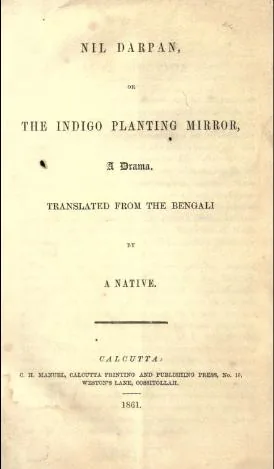
The revolt found a broader audience on the stage. Dinabandhu Mitra’s play Nil Darpan, “The Mirror of Indigo,” published in Dhaka in 1860, follows one farming family as the indigo system destroys it. Its patriarch, Golok Chandra Basu, dies by suicide in a planter’s jail. His son Nobin Madhab, who tries to protect the village, is killed after a planter named Wood strikes him on the head. The planters in the play are not subtle. The same preface addressed them directly: “Oh, ye Indigo Planters! Your malevolent conduct has brought a stain upon the English Nation.”
An English translation followed in 1861, commonly attributed to the poet Michael Madhusudan Dutt and published by the Irish missionary Reverend James Long. The planters sued Long for libel. He was convicted, fined 1,000 rupees, and sent to prison for a month. The Bengali writer Kaliprasanna Singha paid the fine. The case made the play famous far beyond Calcutta, and in 1872 Nil Darpan became the first play ever staged commercially at Calcutta’s new National Theatre.
The colonial government had already appointed an Indigo Commission in 1860, and its findings conceded that the contract system was coercive. Edward De Latour, a former magistrate of Faridpur, told the commissioners that “not a chest of indigo reached England without being stained with human blood.” As a magistrate, he said, he had seen ryots brought before him “speared through the body.” The government made clear that ryots could not be forced to grow indigo, and within a few years forced cultivation in Bengal had largely collapsed. Many planters moved on.
The industry’s center shifted north to Bihar, where planters were already established, and the same system would last another half century.
↑ Table of ContentsThe Chemists’ Blue
Part Four of this series told the story of alizarin: how German chemists learned to make madder’s red from coal tar, and how BASF beat William Perkin to the patent office by a single day. Indigo was the next prize, and it was a much harder one.
Adolf von Baeyer began working on indigo in Berlin in 1865 and kept at it through moves to Strasbourg and Munich. By 1882 he and Viggo Drewsen had produced indigo in the laboratory from 2-nitrobenzaldehyde and acetone, and in 1883 Baeyer published the molecule’s correct structure. Knowing what indigo was and making it cheaply were separate issues. Baeyer’s route used starting materials that cost far more than the plant.
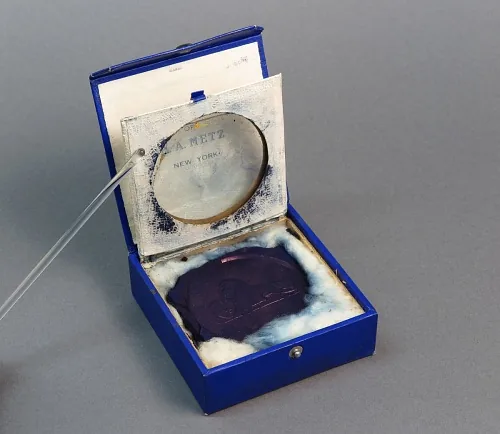
BASF licensed the work and kept going. The breakthrough came in 1890, when Karl Heumann, a German chemist working in Zurich, found a route from anthranilic acid. BASF spent seven more years turning it into an industrial process, including a cheap way to make that starting material from naphthalene, a byproduct of coal tar. By the company’s own account, the effort took seventeen years of research and 18 million gold marks, more than BASF’s entire share capital at the time. In 1897, “Indigo Pure BASF” went on sale. Baeyer received the Nobel Prize in Chemistry in 1905.
At the Nobel ceremony, the president of the Royal Swedish Academy of Sciences noted that the price of indigo had already fallen to a third of what it had been, and that Germany’s synthetic indigo exports for 1904 were worth more than 25 million marks. “The effects of this discovery, which was made in the Munich University laboratory, can already be traced as far as the banks of the Ganges,” he said. He expected India’s indigo fields to be turned over to “cereals and other foodstuffs for India’s starving millions.”
Synthetic indigo did to the plant what synthetic alizarin had done to madder. It was purer, more consistent, and eventually far cheaper, and within a generation the natural indigo trade that had funded the factory system collapsed. The plantations of Bengal and Bihar lost their market, and a few years later the farmers of Tokushima lost theirs.
Champaran: The Stain That Stayed
Typically these natural dye histories end with the rise of a synthetic molecule, but the system outlived its own economics.
In Champaran, in Bihar, planters held tenants to an arrangement called tinkathia: three kathas (a unit of land size) out of every twenty had to be sown with indigo for the landlord. When synthetic dye made the crop worthless, some planters extracted cash payments from tenants in exchange for releasing them from the obligation. The tenants had to pay to be freed from growing a crop nobody wanted anymore.
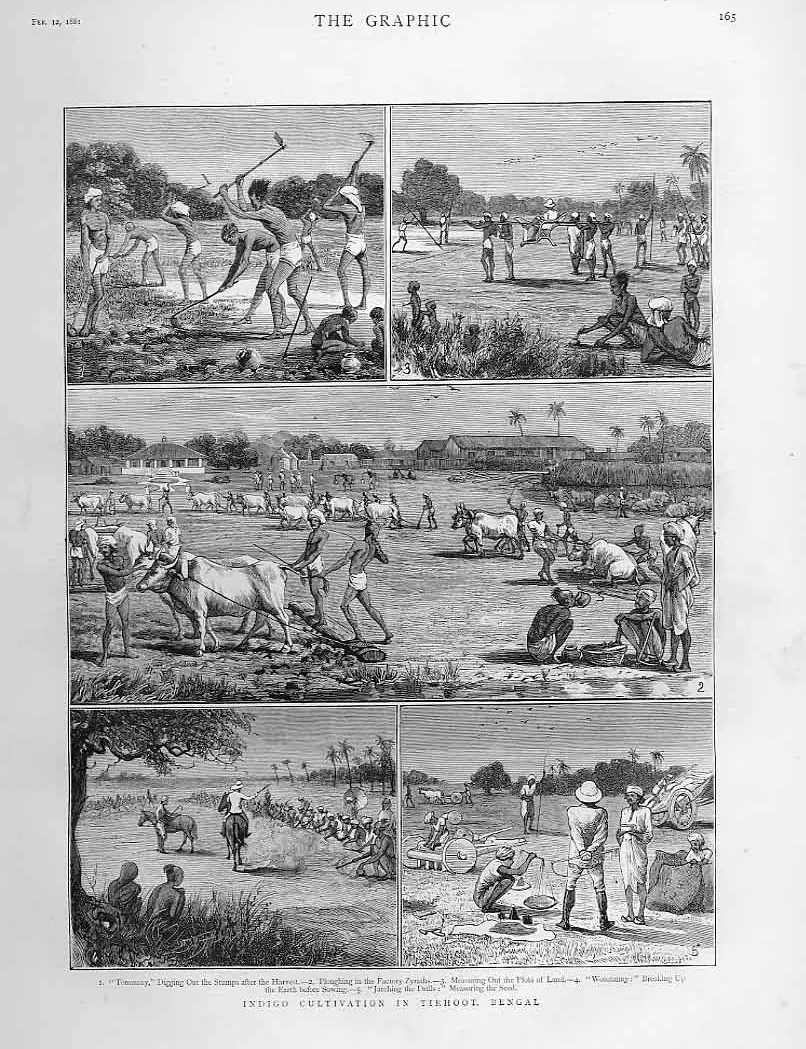
In 1917, a local farmer named Raj Kumar Shukla persuaded Mohandas Gandhi to see Champaran for himself. Gandhi’s investigation became his first campaign of civil disobedience in India. A government inquiry followed; Gandhi sat on it, and the settlement abolished tinkathia and ordered planters to refund 25 percent of the money they had taken. Within a decade the planters had left the district. Gandhi wrote that the ryots “now somewhat came into their own, and the superstition that the stain of indigo could never be washed out was exploded.”
Bengal’s indigo story is usually told as a revolt made pointless soon after due to the advent of synthetic indigo. It is closer to the truth to say the revolt ended the terrible conditions in a single place, the laboratory ended the money, and the final push came from Gandhi’s first campaign in India, the beginning of his leadership in the fight for independence from Britain.
↑ Table of ContentsTokushima: The Living Vat
Japan’s indigo story runs almost in reverse.
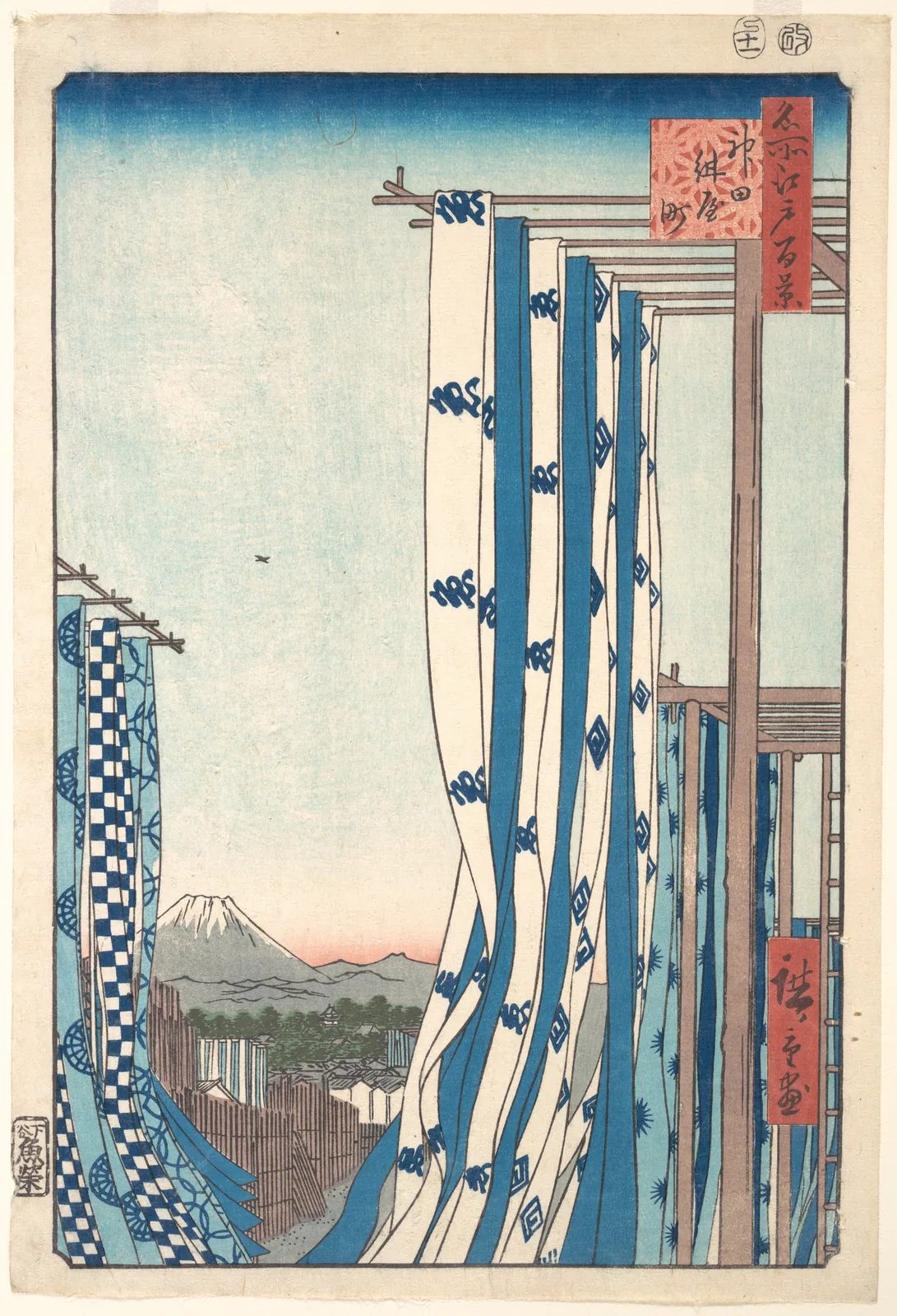
Indigo reached Japan from China by the late seventh century. It spread slowly through the court and temples, then throughout the land. Japan’s medieval samurai wore indigo-dyed cloth under their armor, partly because it was believed to help prevent the rashes armor caused. The darkest shade became known as kachi-iro, and warriors are said to have favored it because kachi also sounds like the word for victory. By the Edo period (1603 to 1868), indigo was everywhere: on farmers, fishermen, merchants, and firefighters, on shop curtains and bedding. When the British chemist Robert William Atkinson arrived to teach in Tokyo in 1874, he saw so much of it that he is credited with calling the color “Japan blue.”
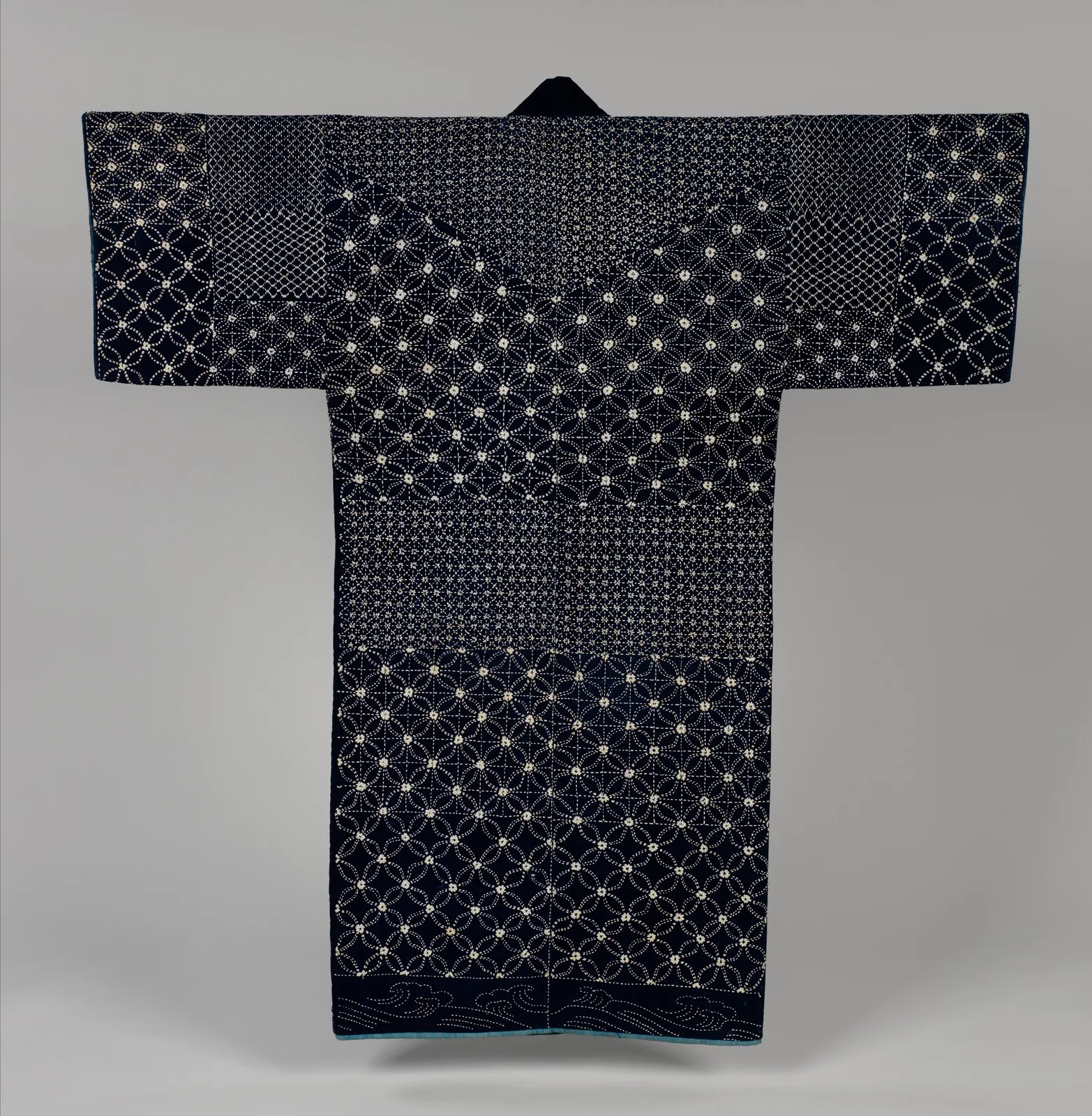
The heart of that blue was Awa province, now Tokushima prefecture, on the island of Shikoku. The Yoshino River flooded every year and laid down fresh silt, and tade-ai, which is said to exhaust soil quickly, thrived on it. The feudal domain promoted and protected the trade, and Awa merchants sold the dye nationwide. By 1889, indigo money had made Tokushima Japan’s tenth most populous city.
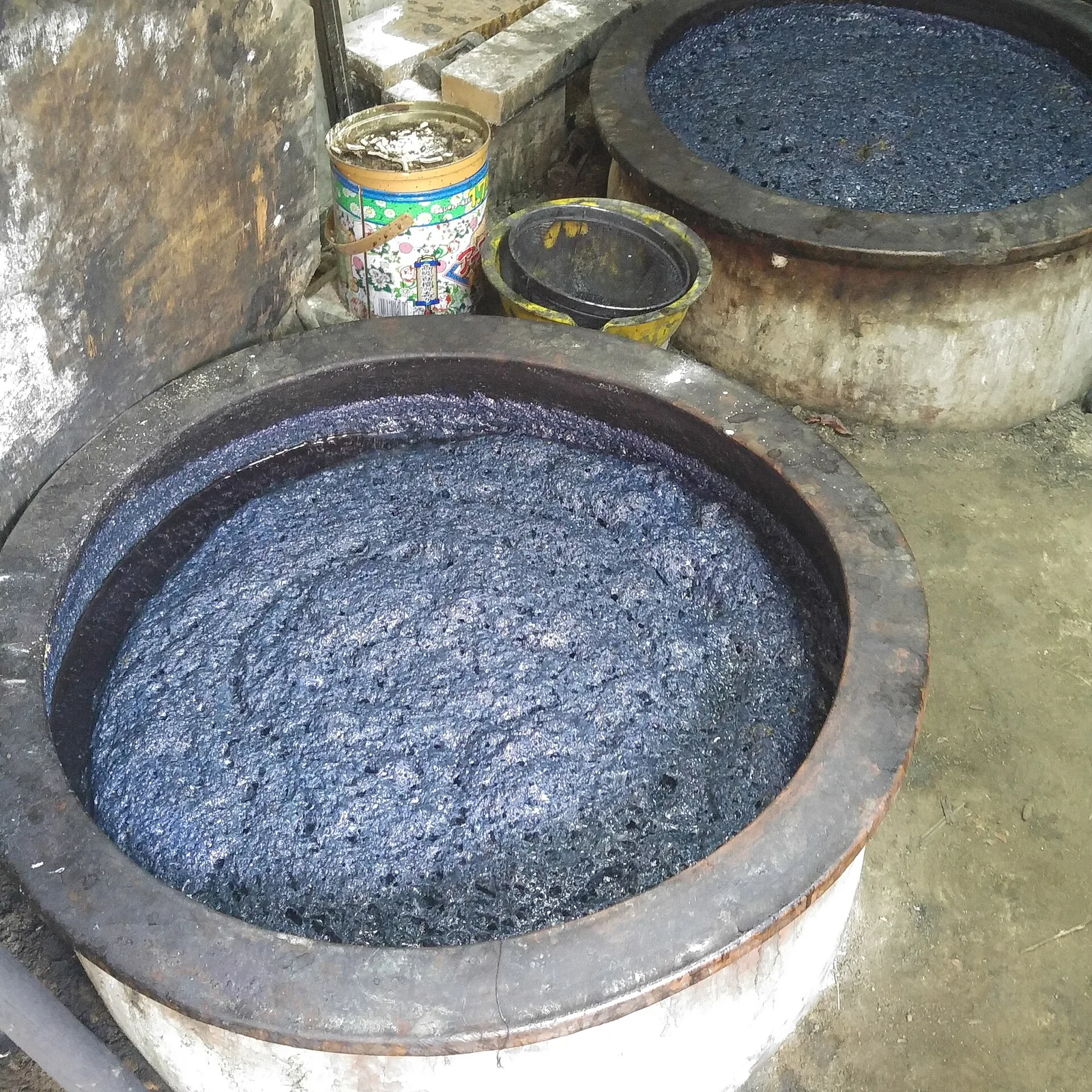
Tokushima sold neither the plant nor the pigment. It was sukumo, and the people who made it were called aishi, indigo masters. Growers harvest the leaves in summer, dry them, and pile them in a nedoko, a fermentation shed, where for roughly a hundred days, sometimes longer, they are watered and turned by hand while the temperature is watched closely. The result is sukumo — a dark, crumbly compost that holds the indigo in a form a dyer can wake up in the vat. Part One mentioned this stage in passing: 120 days of fermentation and 60 days of drying before the plant becomes usable dyestuff. This is where that time goes.
The vat built from sukumo is alive. Dyers add wood-ash lye and lime to keep it alkaline and feed its bacteria with ingredients like wheat bran, sake, and syrup. Dyers watch for a coppery foam on the surface, which Japanese dyers call ai no hana, the indigo flower, and for the smell that tells them the vat is healthy. They passed the knowledge down through practice, not documentation, which made it both durable and fragile.
Awa indigo peaked in 1903, when Tokushima grew about 15,000 hectares of tade-ai. Then it fell hard. Two imports did the damage: synthetic indigo from Europe and precipitated natural indigo from India, cheaper and more concentrated than sukumo. Some of that Indian indigo likely came out of the plantation system described above. The blue that one country’s peasants were forced to grow helped push another country’s farmers out of business.
The scale of the collapse is easiest to see in the head count. During the Edo period, roughly 1,800 indigo farmers worked in the region. By 2015, five farms were still making sukumo.
Tokushima’s craft was able to survive because it stopped competing based on price. The farms that still make sukumo sell what no synthetic dye can replace: the process itself. Japan also chose to protect it. In 1978, the national government named Awa indigo production a Selected Conservation Technique, a category for traditional skills it considers essential to preserving the country’s cultural heritage, and certified a preservation association in Kamiita, Tokushima, to keep the method alive and train the next generation of makers.
↑ Table of ContentsThe Blue in Your Jeans
Indigo had one more turn to take, back in America. In 1873, Levi Strauss, a Bavarian-born dry-goods merchant in San Francisco, and Jacob Davis, a Latvian-born tailor in Reno, received a patent for riveted work pants. The cloth was denim, dyed with indigo.
Everything that makes jeans fade the way they do comes back to the chemistry at the start of this essay. Indigo sits trapped inside the cotton rather than bonded to it. Denim warp yarns are dyed in repeated dips, as Dyed in the Wool described, so the color builds up in the outer layers while the core stays pale. That weak hold is why indigo crocks and abrades so readily. Wear a pair long enough and the blue leaves first where you rub hardest: the knees, the thighs, the pocket edges.
The indigo in almost every pair of jeans made today is synthetic, the descendant of BASF’s 1897 product. The plantations are gone. The molecule is the same one that grew in Bengal, fermented in Tokushima and Kano, and was beaten out of steeping vats on the Wappoo Creek.
↑ Table of ContentsModern Makers
Nearly every pair of jeans on earth is dyed with indigo, which makes it the hardest color in this series to pick makers for. The ones below do something specific with it — returning it to the places it was taken from, or rebuilding parts of the process others don’t.
Some of the links below are affiliate links. If you buy through one, I may earn a small commission at no cost to you.
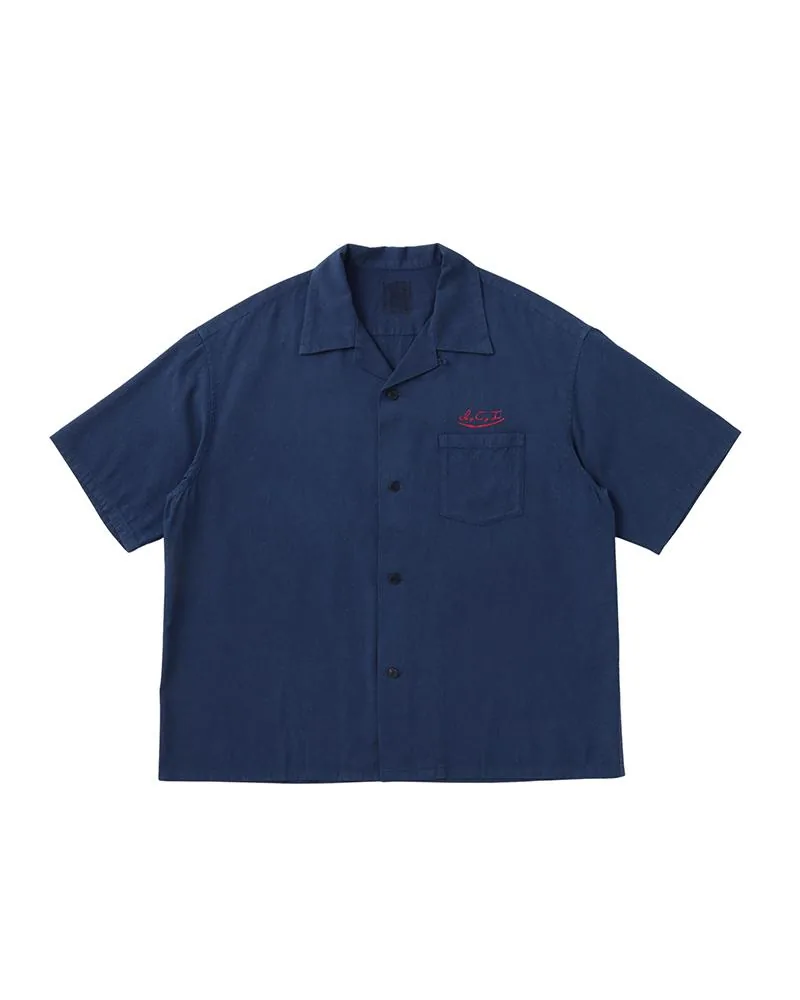
BUAISOU, Tokushima. Kenta Watanabe and Kakuo Kaji founded BUAISOU in 2012 as Tokushima’s sixth and youngest indigo farm. They do every step themselves: growing tade-ai near the Yoshino River, composting it into sukumo, building fermentation vats with ash lye, lime, and wheat bran, dyeing, and sewing their own menswear and goods. In Japan, farming indigo and dyeing with it have traditionally been separate trades, and BUAISOU is one of the very few operations doing both under one roof. They have learned from Osamu Nii, a sixth-generation indigo farmer, and they have run a workshop in Brooklyn with sukumo shipped from Tokushima.

visvim, Tokyo. Hiroki Nakamura founded visvim in 2000, and natural dyeing has long been one of the label’s preoccupations. For its aizome, or indigo-dyed, pieces, visvim has worked with Kosōen, the Murata family’s dye workshop in Ōme, an old textile town on Tokyo’s western edge, which dyes from fermented sukumo. Its Indigo Camping Trailer line pairs natural indigo with traditional mud dyeing from the island of Amami Ōshima, on shirts, sweatshirts, and tees made in Japan.
Kardo, New Delhi. Rikki Kher, who grew up in London and moved to Delhi in 2004, founded Kardo in 2013 to make menswear by hand in India, with each garment sewn from start to finish by a single tailor. Its craft line is dyed with natural indigo and made by artisan families across the country. The YOSHI work jacket is cut from bandhani, tie-resist cloth made by Suraj Narayan Titanwala and his family in Bagru, Rajasthan, who trace their dyeing lineage back about five hundred years, and finished with kantha, the running stitch of Bengal’s quilts.

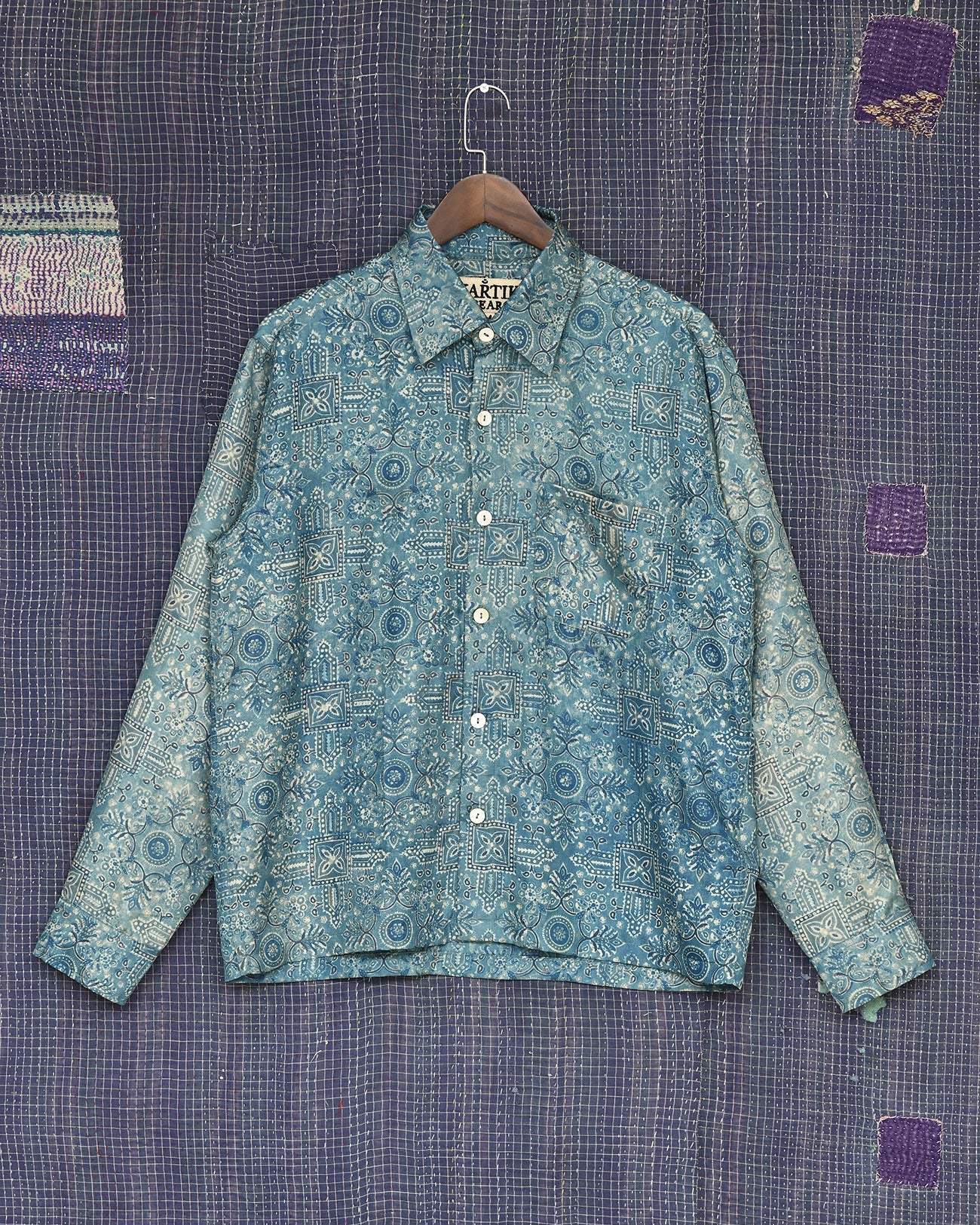
Kartik Research, New Delhi. Kartik Kumra started the label in 2020, at first under the name Karu Research, to make contemporary menswear through India’s artisan networks, from handloom weavers in Andhra Pradesh and Bengal to natural dyers in Karnataka and Odisha. It now shows in Paris and opened a store in New York in 2025. Its shirts include handloom Eri silk from Assam dyed in iron and indigo, and silk hand block-printed in natural indigo by ajrakh printers in Gujarat.
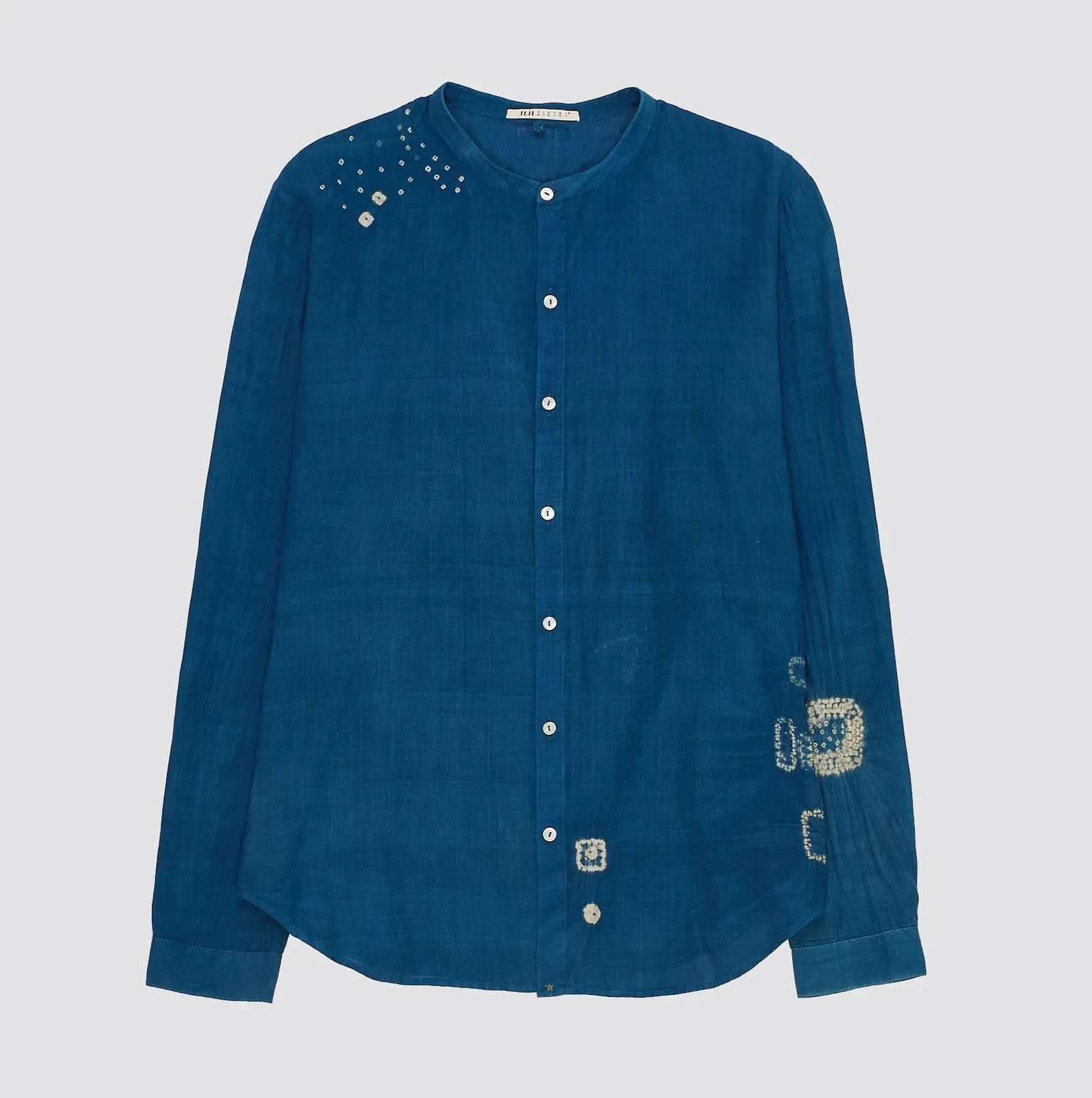
11.11 / eleven eleven, India. Founded by Shani Himanshu with designer Mia Morikawa, 11.11 makes handspun, handwoven denim from kala cotton, a short-staple, rain-fed cotton native to Kutch in Gujarat. The cotton is handspun, dyed with natural indigo, and woven on handlooms before it is cut and sewn. It is denim that runs, at every stage, on the handcraft that the factory system and industrial cotton replaced.
Aboubakar Fofana, Mali. Born in Bamako in 1967, Fofana trained as a calligrapher in Paris and spent years traveling across West Africa and to Japan to learn fermented indigo vat dyeing from the people still practicing it. He is now among the world’s best-known practitioners of the West African fermented vat, and his work was shown at documenta 14 in 2017. He has since built an indigo farm with the community at Siby, in southern Mali. In his statement for documenta 14, he wrote of indigo: “Its blue compares with the heavens, and all over the world, newborn babies are swaddled in it, brides are bedecked in it, and the dead are venerated by being wrapped in it.”
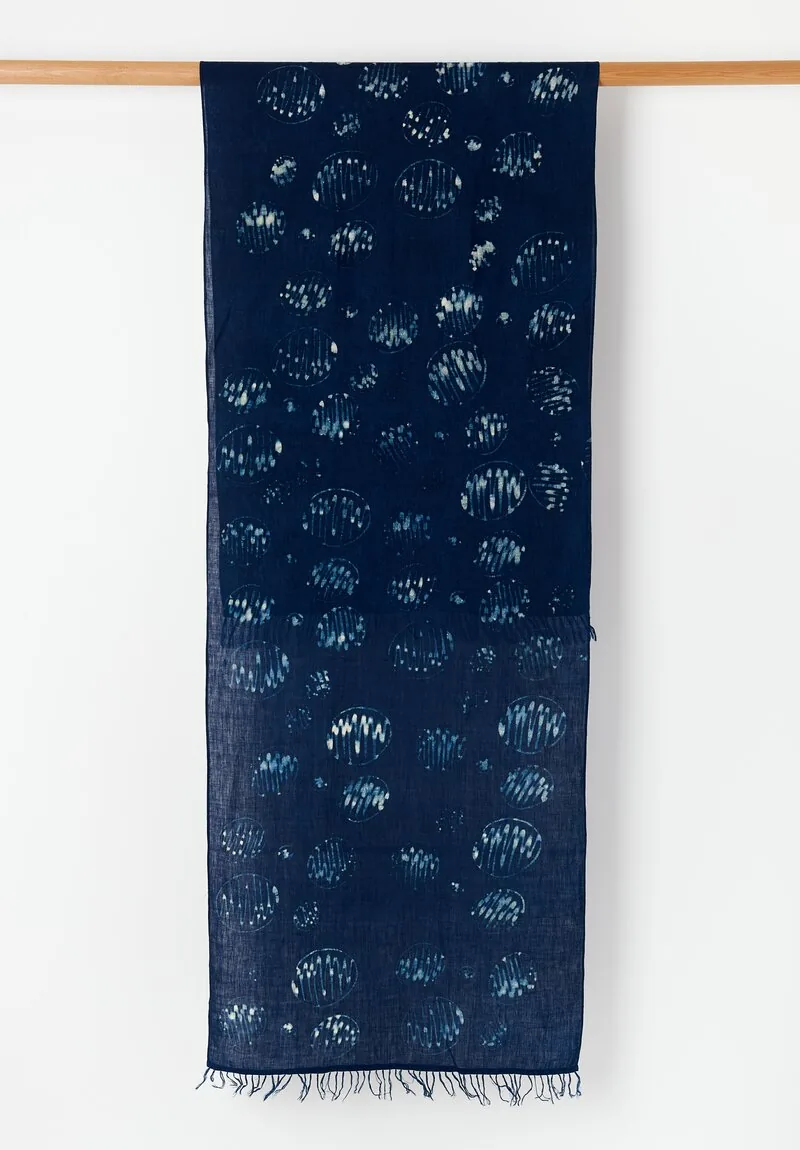
CHI Design Indigo, Charleston. Caroline Harper started growing indigo in the Lowcountry more than a decade ago, processing the plant and extracting the pigment herself to dye a line of shawls, scarves, and home goods. In 2016 and 2017, the studio dyed with indigo grown at McCullough Farms in Kingstree, South Carolina, part of a federally funded trial to see whether the crop could be raised there again at scale. Harper has since moved to France, and Raffaella Riva, who came to Charleston from the Italian fashion industry in 2022, now runs the studio.

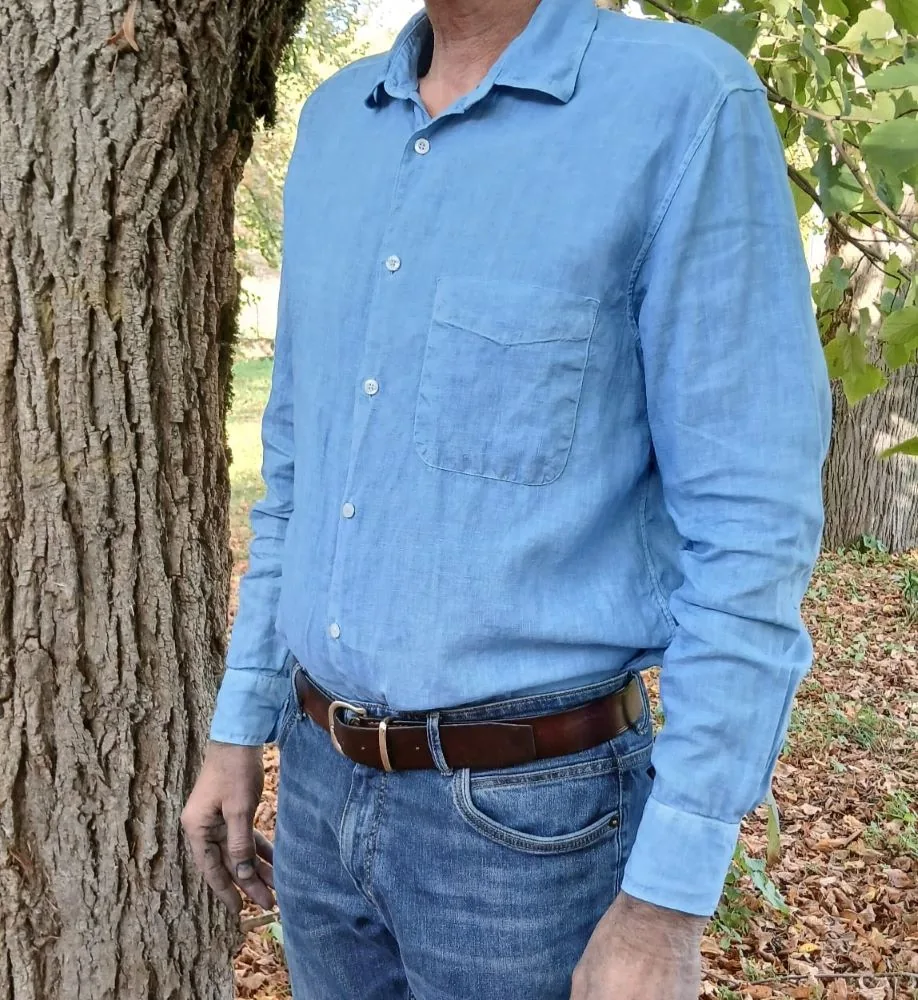
Bleu de Lectoure, France. In 1994, Henri and Denise Lambert bought an old house near Lectoure, in Gascony, and became curious about the faded blue on its shutters. Working with a laboratory in Toulouse, they recovered the process for extracting dye from woad. Bleu de Lectoure revived woad as a working dye in southwest France, near the old Pays de Cocagne, and under new owners it still sells woad-dyed clothing, scarves, and linens. In 2021, woad dyeing in the Pays de Cocagne was added to France’s inventory of intangible cultural heritage.
What Blue Still Owes
Indigo was never a secret like cochineal, and unlike snail purple, it was never scarce. Anyone who wanted to could learn where it came from. The fights in this essay were over who owned the fields and who got paid when the dye sold.
The planters of Bengal lost first to a revolt and then to a German laboratory. Champaran’s held on until 1917. Tokushima’s farmers lost their market but kept their method, and a handful of farms still make sukumo by hand. In Kano, dyers are still working pits first dug in the fifteenth century. Carolina’s crop died with its bounty, and the people who had grown it were put to work on cotton.
The brick shells of the indigo factories still stand in Nilphamari’s rice fields. The molecule that came out of those vats is in nearly every pair of jeans made today, now made in chemical plants instead of steeped from leaves.
Gandhi saw the stain of indigo washed out of Champaran. The stain it left on the people who made it can’t be washed away.
Next in the Dye Series: Green, the color that rarely comes from nature, and the final part of Built for Color. In the meantime, the Fit Finder can help you find denim that fits your body, with suggestions based on real measurements, not size-tag mythology.