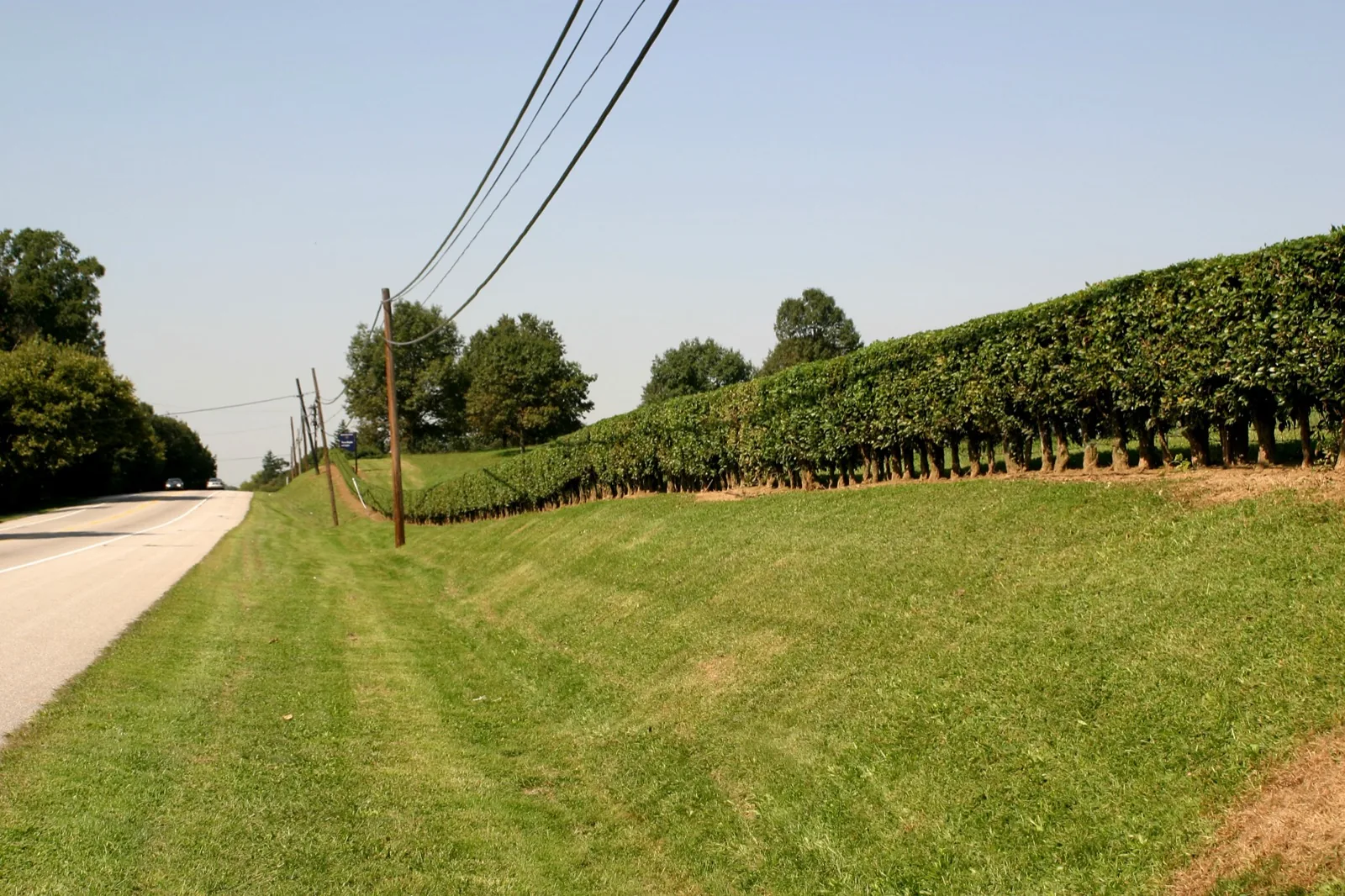
For most of the nineteenth century, if you were crossing the American prairie, you could follow a fence line made entirely of trees. Planted close together, pruned hard, and trained to grow into a wall. Osage orange, thorned and stubborn, was a popular fencing material in the Midwest before barbed wire made it obsolete. It was a hedge you could not walk through and that a cow could not push over. What many of the farmers who planted it never used, and may never have known, is that the same tree’s heartwood yields one of the most reliable golds in the natural dyer’s kit.
Yellow is everywhere in the plant world, more common, if anything, than red or true blue, but yellow is underrepresented among surviving textiles relative to its historical use. Something happens to fiber after it’s dyed yellow. Mostly, that something is light.
Easy to Find, Hard to Keep
If you compare yellow to the colors already covered in this series, you’ll find a stark contrast. Indigo’s blue molecule, indigotin, once oxidized, becomes insoluble and is held within the fiber, giving indigo resistance and light. Red, once you had cochineal or kermes in hand, cooperated too. Add alum to the dye and you had a stunning crimson that people told tales of for centuries. That is not the story of yellow.
Orange has it worse and appears even less than yellow in the historical textile records, let alone enough material to justify an essay of its own. That is why it is folded into this piece rather than saved for an installment that would have nothing to fill it. Consider it the same sunshine problem, one shade further around the wheel.
Weld: The Closest Thing to a Reliable Yellow
Weld (Reseda luteola) is the closest thing the pre-synthetic world had to a dependable yellow. Its colorant is luteolin, a flavonoid concentrated throughout the leaves, stems, and seed capsules, and harvested at flowering for maximum yield. On alum-mordanted wool, weld produces a bright, clean yellow that is, by the standards of natural dyes, unusually lightfast. That single property is most of why weld became one of the staple dyes of the medieval European trade, standing alongside woad for blue and madder for red. It appears in the Bayeux Tapestry. It remained in use from Scandinavia through the Middle East for centuries, which is a significant time for any dye plant to remain commercially important.
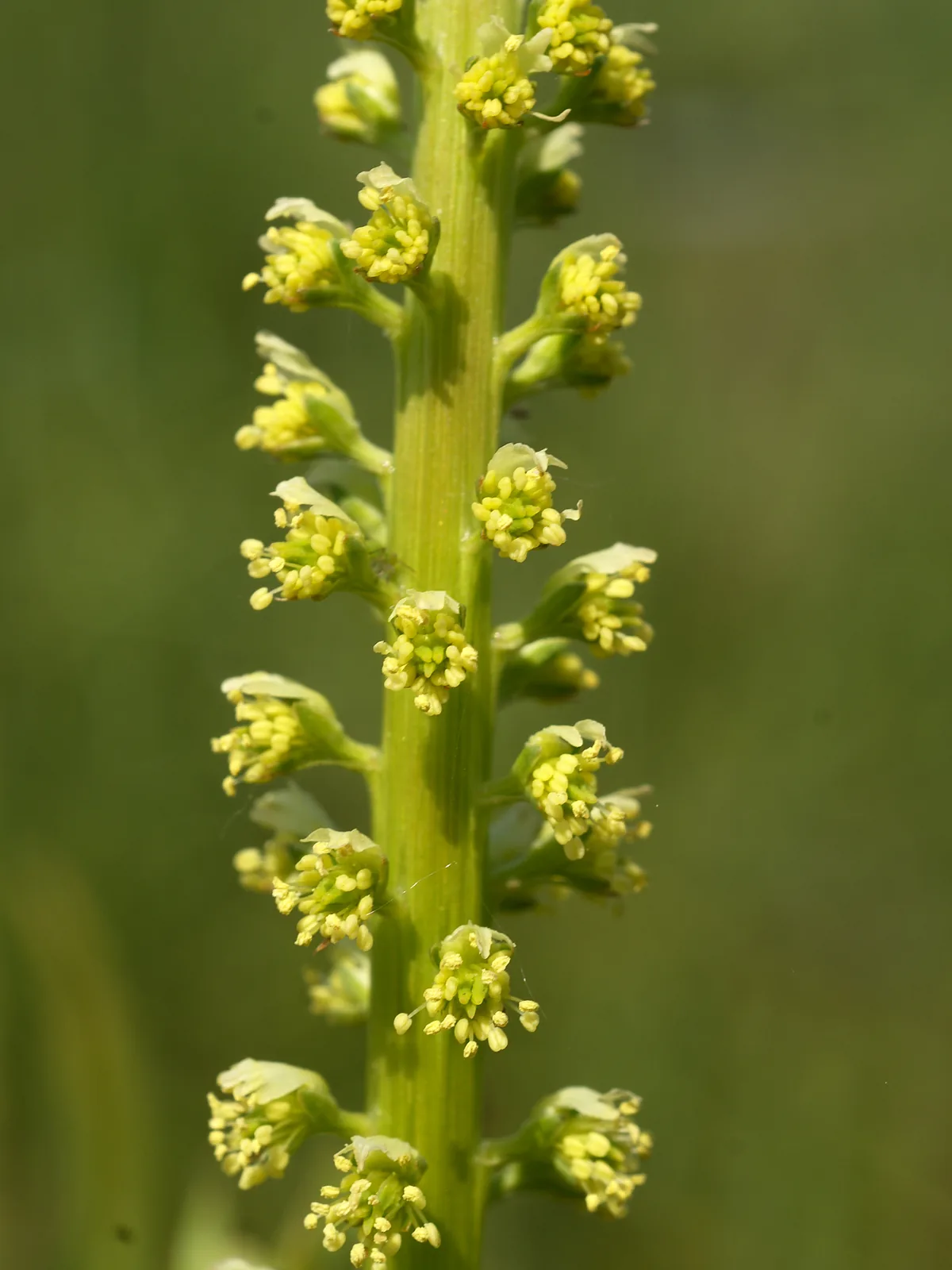
“Unusually lightfast” is a relative claim, though. Weld fades more slowly than the other yellows in this piece, but it does fade. Weld’s role in historical green points to the same problem: when weld yellow is paired with woad blue in an overdye, the yellow degrades first, and centuries later a museum textile designed to read as green reads as blue-green, or blue, instead. Weld is the best of a difficult category, but it is not without its flaws.
Myrobalan: The Tannin That Survived Industry
Before myrobalan became a popular choice for coloring cloth, it was a medicine. The dried fruit of Terminalia chebula, native from the sub-Himalayan belt of Nepal and northern India down through Sri Lanka, Burma, Thailand, Indochina, and southern China, is one of three fruits in Triphala, the Ayurvedic compound still described as the “King of Medicine” in Tibet. Its earliest written mentions run through the Charaka Samhita in the first century CE and the Sushruta Samhita in the sixth, with the Bhavaprakasha Nighantu still citing it thirteen centuries later. Its medicinal use clearly predates its documented importance as a dye and tanning material. This is the same pattern we see in walnut, back in Part Five, where Cherokee and Chippewa dyers used black walnut hulls as medicine and dye together, the two uses never fully separated.
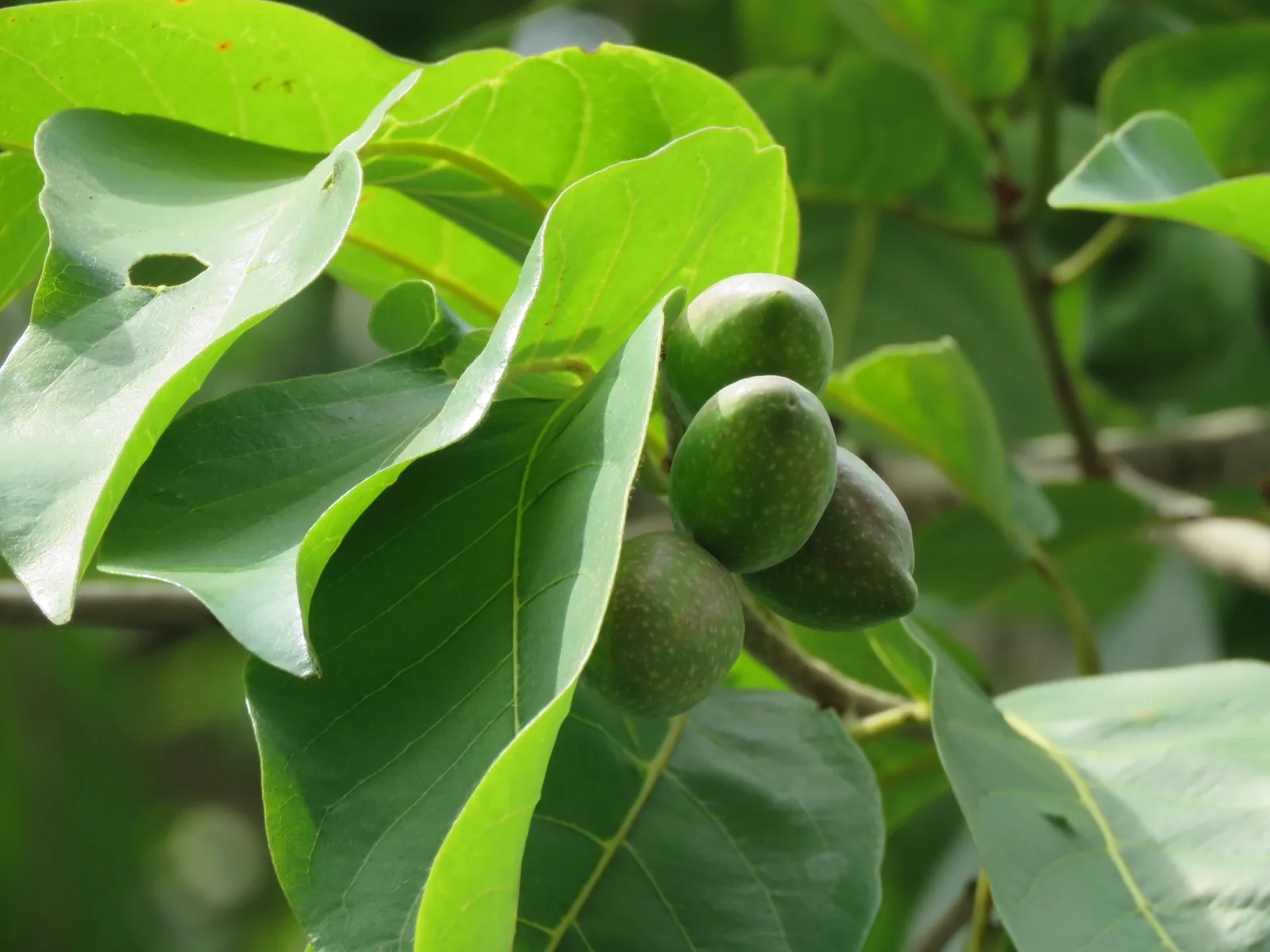
Myrobalan left South Asia the way a lot of the region’s plant knowledge did, through Arab trade networks. It shows up in tenth-century Islamic medical literature and became one of the most common drugs in medieval European medicine, carried west alongside the dyes and aromatics. Europe wanted it for the medicine first. What it got, eventually, was a tannin supply.
That tannin supply became an industry in its own right. Myrobalan fruit runs up to 40 percent tannin by weight, high enough that India used it at industrial scale in leather tanning, on its own and blended with other vegetable tannins like black wattle and avaram. Its story splits from cutch’s here in an interesting way. Part Five traced how chrome tanning, patented in 1884, made cutch obsolete within a few decades. Myrobalan never got displaced the same way. Tanneries started using it as a last tannage, applied after chrome tanning to add weight and fix a fast color, meaning it survived by attaching itself to the very industrial process that ended most of the vegetable tannins around it, rather than by competing against it. The cotton-and-iron pretreatment chemistry behind myrobalan’s color itself, and the Kalamkari tradition built on it, is covered in “A Tale of Two Fibers.”
Osage Orange, Old Fustic, and Jackfruit: Three Trees, One Gold
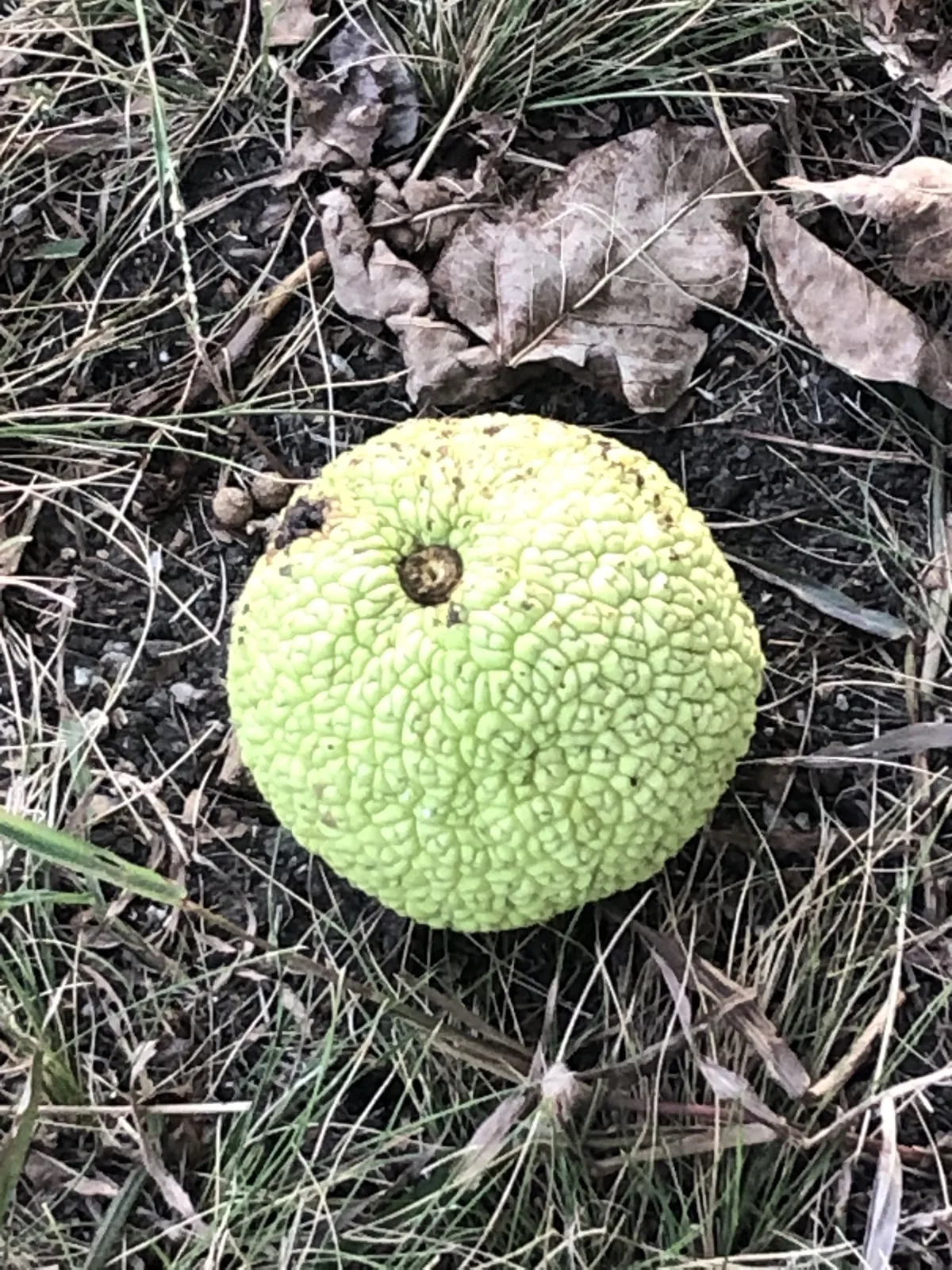
That brings us back to the hedge fence. Osage orange (Maclura pomifera) is native to the south-central United States, where Native communities extracted a clear gold dye from its wood long before the tree became a fencing crop for European settlers. The active compound is morin, pulled from the heartwood, inner bark, or shavings. Depending on the mordant, morin gives a golden tan with alum or a deeper gold with chrome. It also holds its color well against washing, but not necessarily against direct sun.
Morin is not unique to Osage orange. Old fustic, the historical commercial dye wood extracted from Maclura tinctoria, came from a related tree traded out of Central and South America into Europe from the sixteenth century onward, and it produces color through the identical molecule. Two trees from two different continents, no contact between the traditions that used them, and they still converged on the same chemistry. It is the same pattern this series found in cutch and lac: a dye that was fully worked out and commercially significant in one hemisphere while dyers on the other side of the ocean solved the identical problem from scratch.
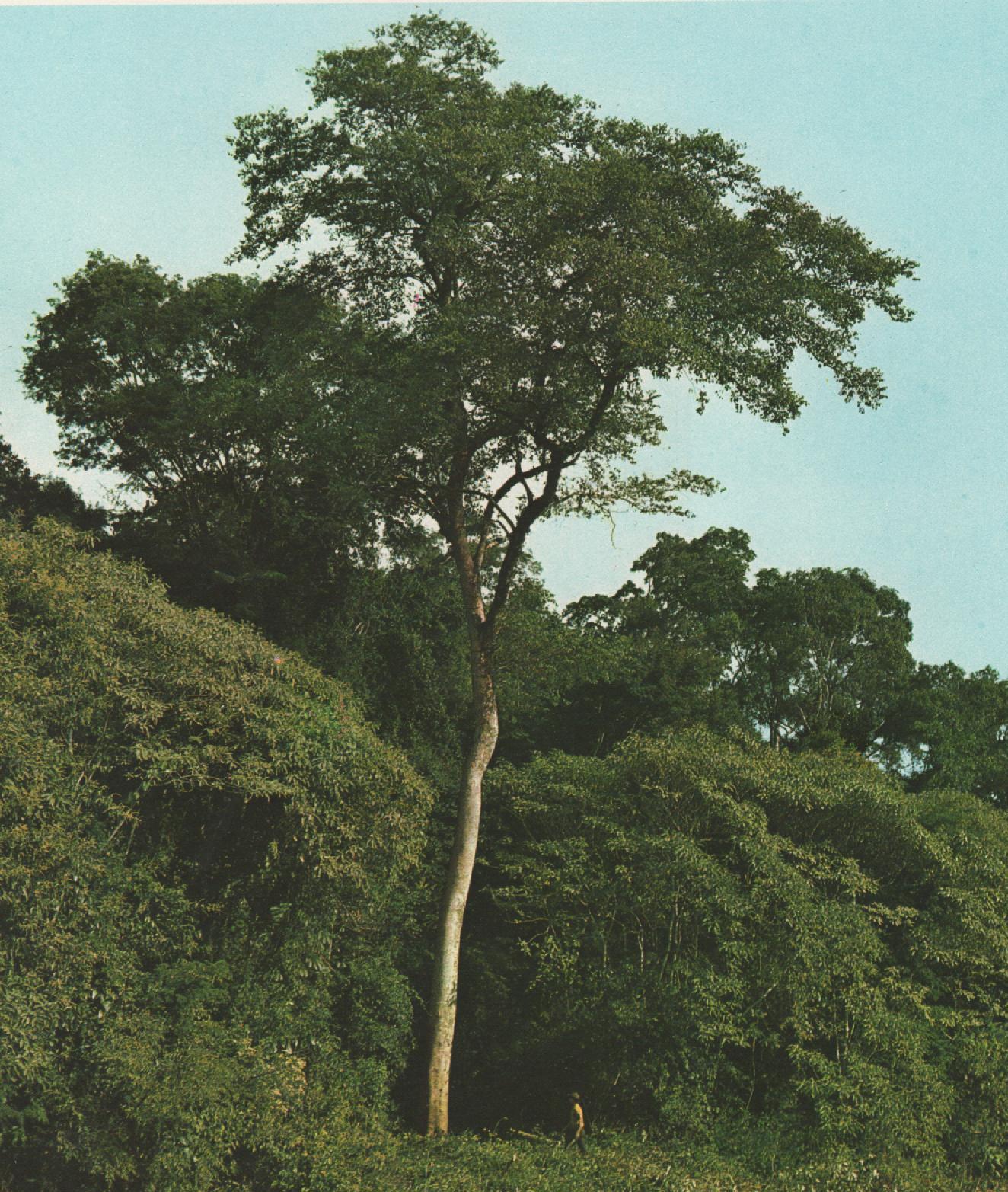
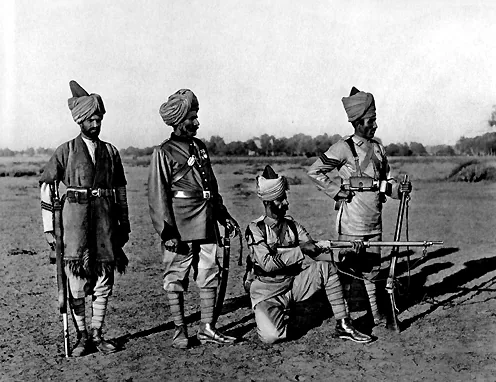
Old fustic’s commercial peak came in the late nineteenth century when the British Indian Army had moved to the khaki field uniform, colored locally by various means before supply for home and colonial regiments increasingly shifted to European dye-works running fustic yellow with an iron mordant. It held that role until synthetic dyes displaced it from military and commercial use in the early twentieth century.
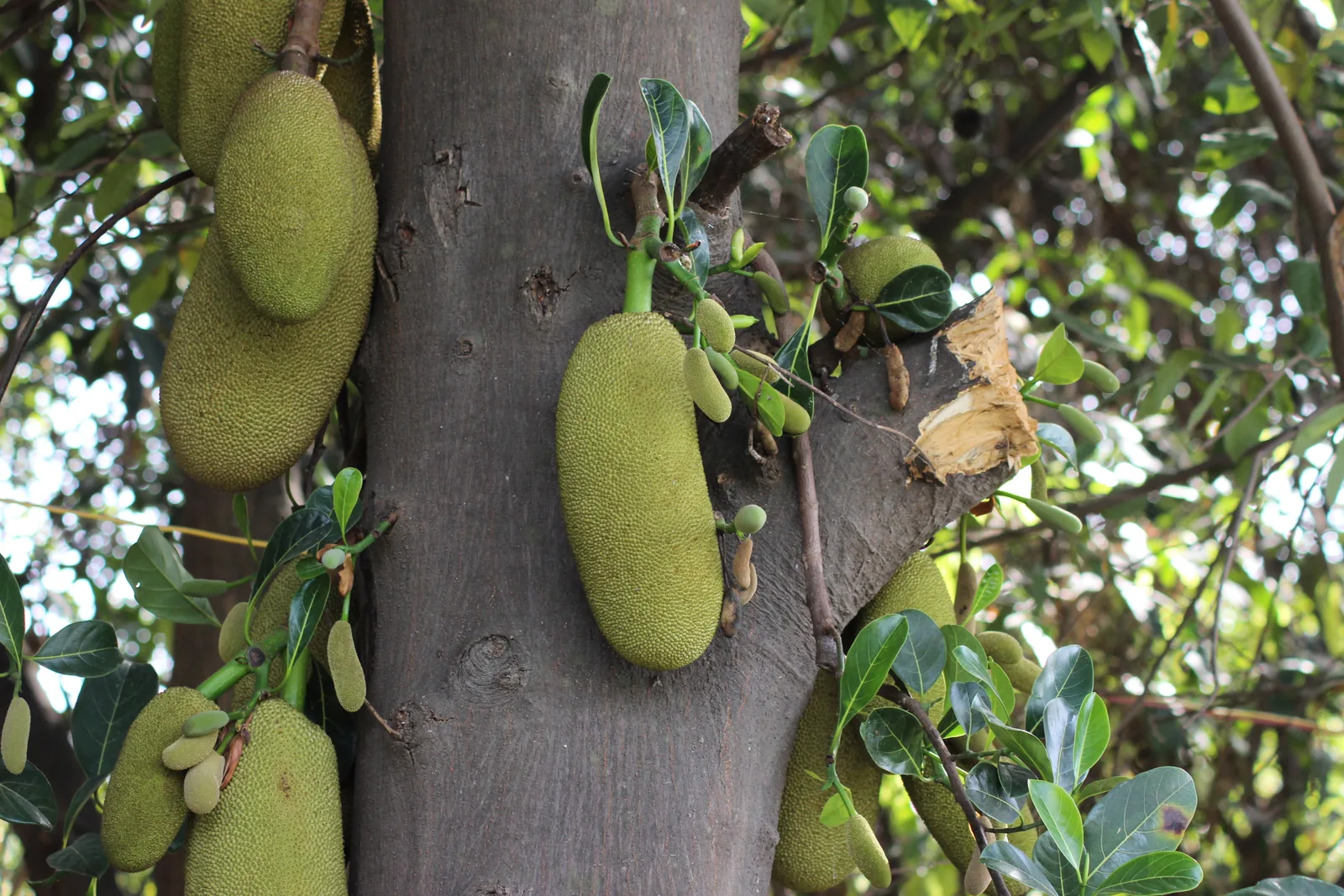
A third source converges on the same molecule from a third continent. Jackfruit (Artocarpus heterophyllus), native to South and Southeast Asia, yields morin from its heartwood and sapwood, extracted by boiling wood chips down into a dark broth. For centuries, it has been one of the primary dyes for Buddhist monastic robes across Thailand and the wider region; forest monks in Thailand still wear robes colored from jackfruit heartwood today. The tradition is old enough that the Buddha is recorded prescribing exactly which plant parts a monk could dye with at all: roots, trunks, bark, leaves, flowers, and fruit, always boiled. Unmordanted, jackfruit gives a dull, “dirty” yellow-brown rather than a clean gold. A metal mordant sharpens it toward a brighter yellow, the same trick that brightens Osage orange. “Saffron robes,” the common shorthand for Buddhist monastic dress, is at least partly a misnomer. A real share of that color historically came from jackfruit wood and other barks, not saffron at all.
Young fustic is a different plant entirely, Cotinus coggygria, the smoke tree. It produces a similar-toned yellow from a different compound, fisetin, not morin. Old fustic and young fustic share a market name and a color family, but come from a different place entirely.
Chamomile: The Garden Plant That Entered the Dye Pot
Dyer’s chamomile (Cota tinctoria, along with the related Chamaemelum nobile and Anthemis arvensis) belongs to the same flavonoid family as weld, with apigenin, quercetin, and luteolin present in different ratios. The relationship between chamomile and weld shows in the dye pot: alum gives a buff, chrome pushes toward gold, and iron saddens into an ocher-olive that reads almost as a different color family entirely. Chamomile is also used to overdye onto indigo for warm greens.
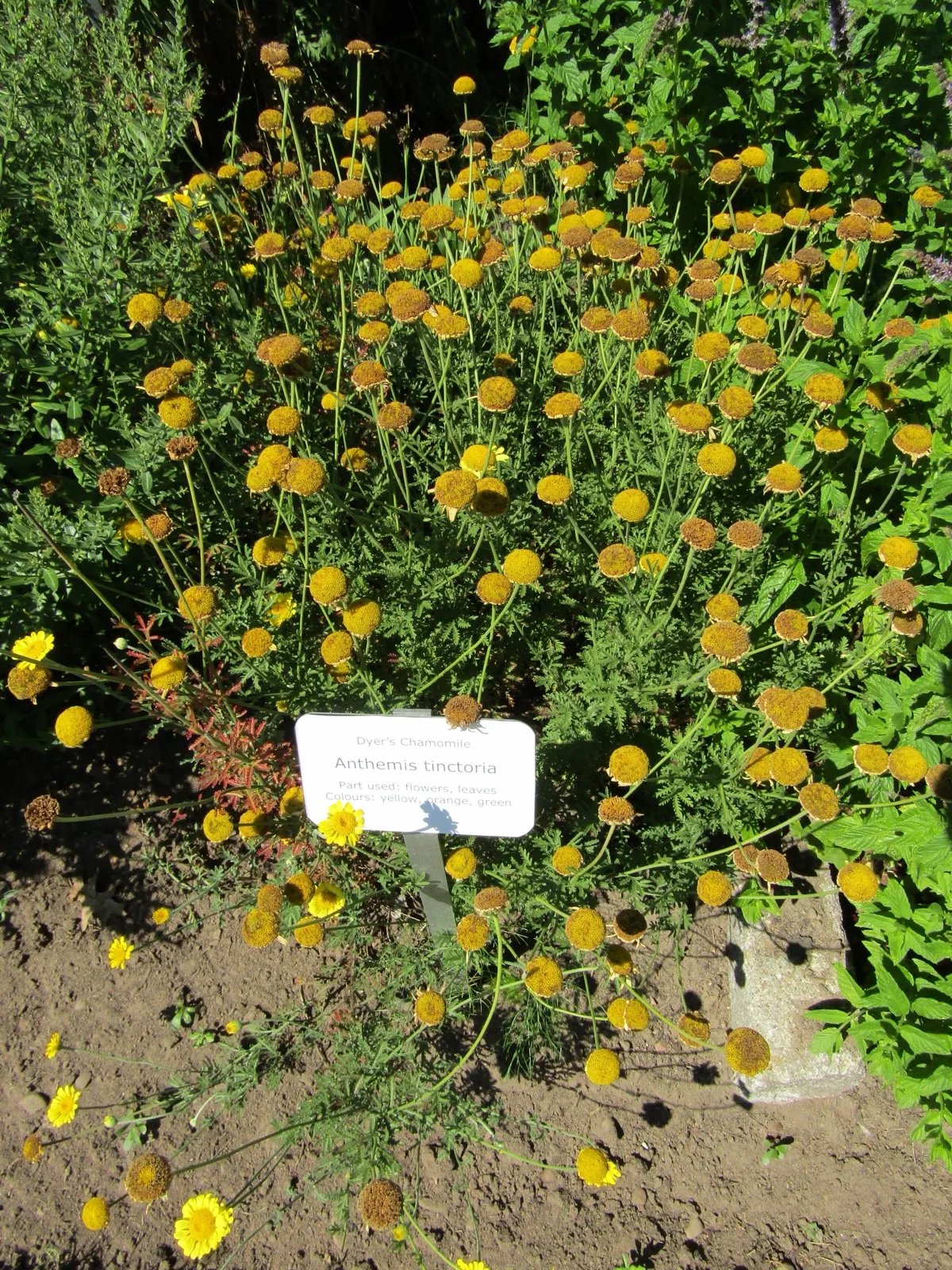
The distinction between chamomile and the others is cultural. Weld and fustic are dye plants first. They were grown, traded, and written into dye manuals because of the colors they produced. Chamomile was already in European gardens, planted for pathways, tea, and medicine, long before anyone treated it as a dye source. Dyeing was a second job the plant picked up, not its original purpose. The plant earns its place in the dye pot by already being close at hand. Onion earns its place the same way.
Onion Skin: The Kitchen Yellow
If weld is the historical anchor, onion skin is the living-practice counterpoint: a universal yellow found in every kitchen. Its colorants are quercetin and related quercetin glycosides, concentrated in the bulb’s dry outer layers.
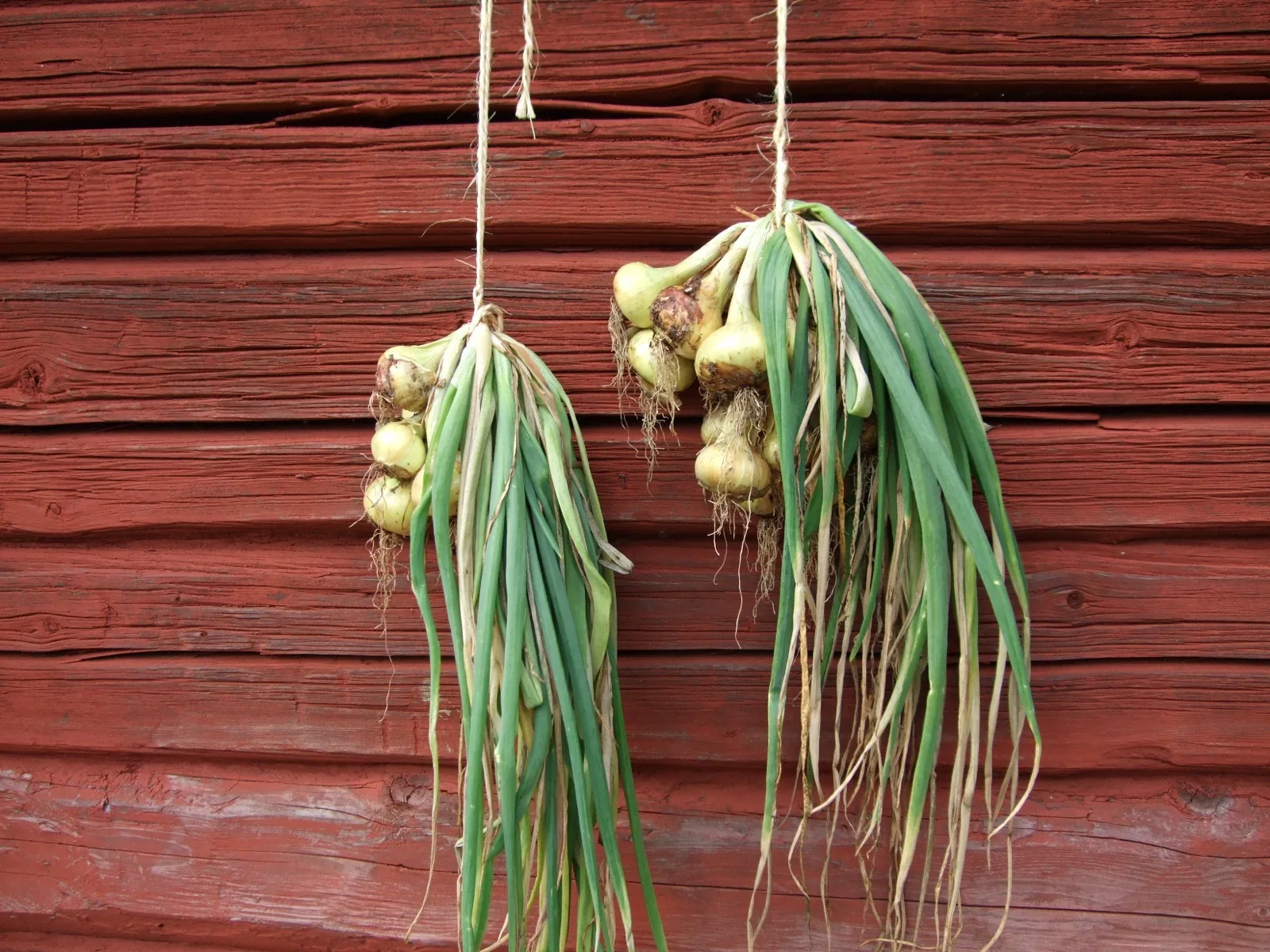
Without a mordant, onion skin gives a mustard tone. Alum pushes it toward the deep golden-orange most home dyers report. Iron pulls it to moss and olive, echoing chamomile’s iron response. What makes onion skin genuinely distinctive is that it works on cotton, a cellulose fiber rather than the protein fibers most natural yellows favor, without a mandatory mordant step, because the skins carry enough natural tannin to do some of that work themselves. It is the most accessible yellow in this piece, and the one a modern dyer is most likely to reach for first.
Marigold: The Sacred Flower That Rarely Became Cloth
Dyers sometimes describe what happens to a poorly bonded yellow as the “gym sock” problem. The dyes applied straight to white cotton or linen with no real mordant to hold them, go through a few wash cycles bright and gold and come out the other side dingy, patchy, and off-white, like an old gym sock. The pigment is not gone, but has been stripped unevenly, degraded by soap and light faster. Marigold, one of the most culturally significant yellow-orange sources in the Americas, runs into a version of the same problem. The reason marigold never became a textile staple has as much to do with culture and economics as with chemistry.
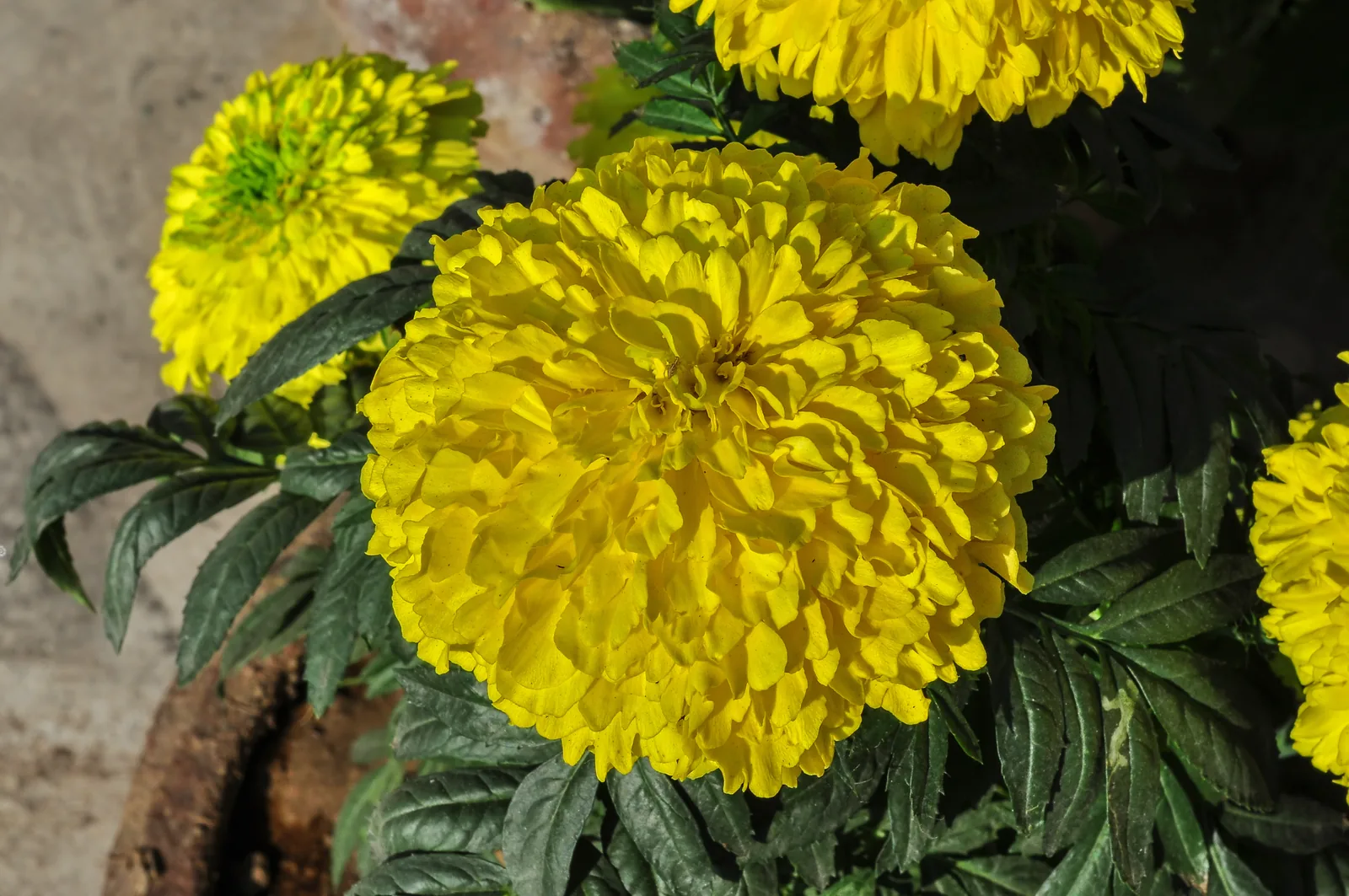
Cempasúchil, Mexican marigold (Tagetes erecta and the related wild Pericón), carries the pigment lutein in concentrations high enough to produce a real, workable gold. It also carries one of the oldest continuous ritual associations of any dye plant we’ve met yet. It is the flower of Día de los Muertos, grown to guide the dead back to the living for one night a year. That association cuts hard against everyday commercial use in many of the communities that grow it. A flower whose cultural significance is funerary and votive does not move easily into a button-down shirt.
The economics compound the cultural resistance. Heirloom Cempasúchil, the variety with enough lutein to hold a strong, lightfast gold, is fussy. It is vulnerable to pests and weather in a way that has made it difficult to grow at commercial scale. Over the last decade, cheaper, more resilient imported and genetically modified marigold seed has taken over much of the commercial growing, and that seed does not carry the same lutein concentration. A dye house that wants a real gold from marigold today has to source scarce heirloom pericón specifically, rather than buy whatever marigold happens to be cheapest at market. That is the opposite of how a commodity dye plant is supposed to behave.
When a Mexican textile house does invest the labor a real natural dye demands, marigold usually is not what gets chosen. Cochineal red, indigo blue, and palo de Brasil’s purples (brazilwood) and pinks are the pigments with the deepest trade history and the strongest lightfast results in Mexican textile tradition, and they command premium pricing internationally. Marigold gold does not carry that same weight, commercially or historically, next to those three. Marigold does work to dye cloth, but when a workshop has to choose which labor-intensive natural dye is worth the investment, marigold loses the fight.
The Many Failures of Yellow
There is no one clean answer to yellow dye the way there almost is with blue. There are half a dozen partial answers, each solving a different piece of the problem of lightfastness, washfastness, etc., with no single dye solving all of it.
Orange takes the same problem and makes it thinner. Yellow is abundant but unstable whereas orange is less common as a natural textile color and often exists historically as a mixture, a shifted shade, or a secondary result of another dye process. That is why it belongs here rather than in a separate installment. It’s not because orange is uninteresting, but because it is slight.
Yellow struggles to survive while orange has barely ever existed as a tradition at all.
Orange: When Yellow Runs Out of Road
The tree that opened this piece is named for a color it does not produce. Osage orange dyes gold, not orange: the fruit gave the tree its name, and the wood gives dyers something else entirely.
Actual orange, in the natural-dye record, is surprisingly scarce. Most of what reads as orange is either a yellow pushed toward red, a red diluted toward gold, or two dyes made to meet in the middle. Orange has a fragmented history.
Built Oranges: Mixed or Pushed
Most natural orange is not a single source doing the work on its own. It is two dyes read together, or one plant’s color pushed further than it naturally wants to go.
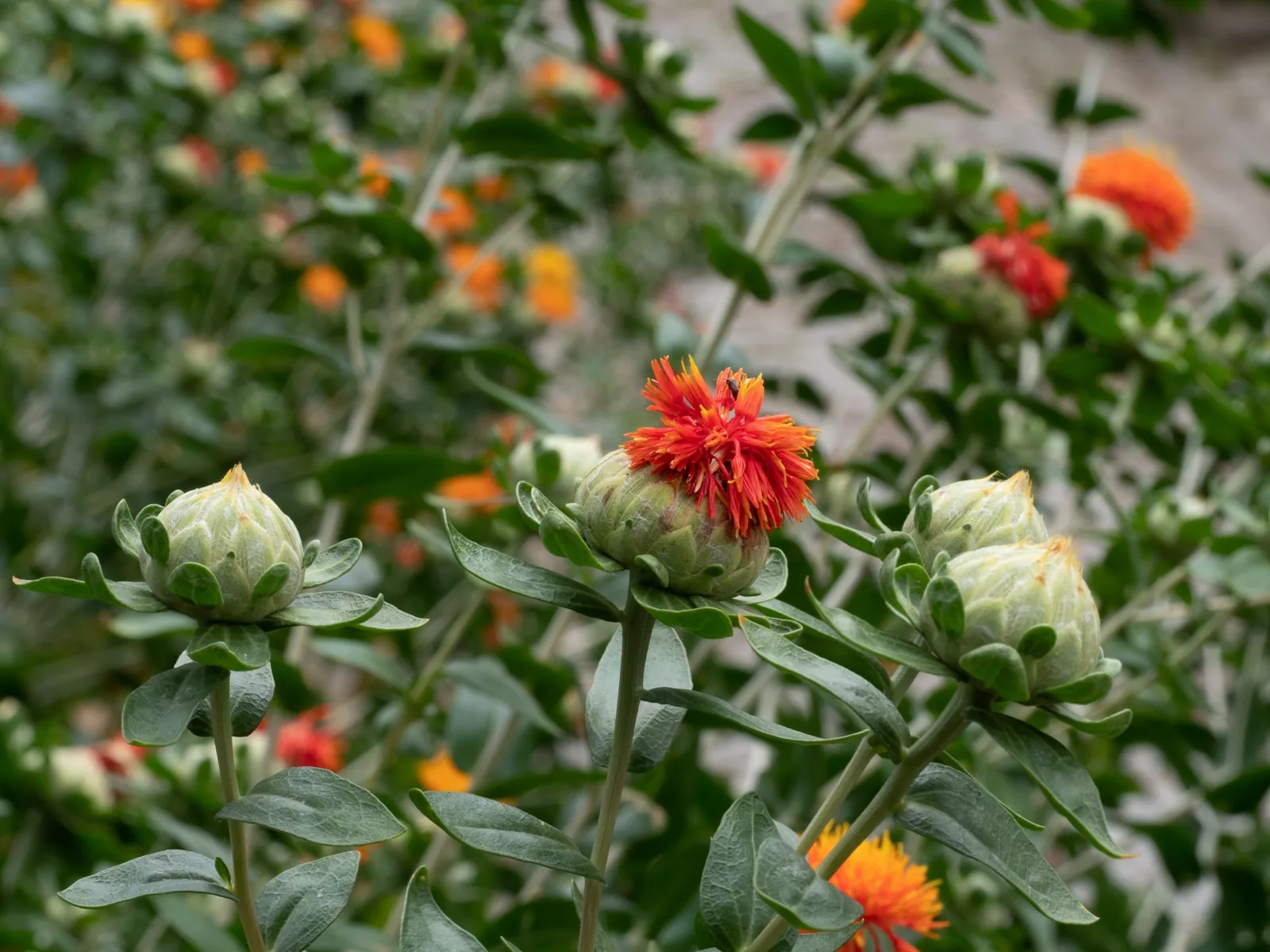
Safflower (Carthamus tinctorius) is the clearest example. Its petals hold two pigments: a water-soluble yellow, usually rinsed out and discarded in classic processing, and the prized carthamin red, isolated through alkaline extraction and famous as the source of Japanese benibana rouge. In some East Asian dyeing traditions, dyers did keep that yellow fraction but would pair it with a second, berberine-based yellow known as kihada, or Amur cork tree bark (Phellodendron amurense), and pushed the mixture toward a fiery orange-red rather than a clean yellow or orange.
Kamala: The Color People Settled For
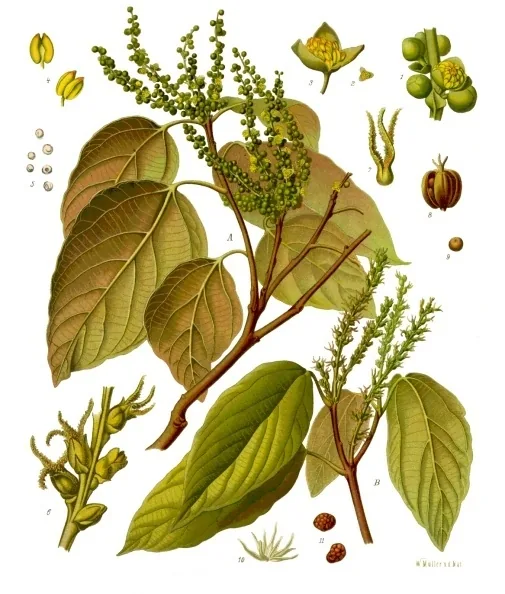
Kamala (Mallotus philippensis) comes closer to a genuine single-source orange, though even here the language is shaky. Its colorant is rottlerin, harvested from the red, powdery glands coating the plant’s fruit capsule. This process has been documented in Western dye chemistry since at least 1855 and used across South and Southeast Asia under regional names including banato in the Philippines. Sources describe the result on silk and wool as a “golden red.” It’s close enough to orange, but still far enough from a clean color that it was rarely used.
Annatto: A True Orange with a Fugitive Life
Annatto (Bixa orellana), native to tropical Latin America, is unambiguously orange thanks to bixin and norbixin which coat the seeds inside the plant’s spiny pods. The Aztec and Maya used it on textiles and murals across dozens of documented sites, in manuscript painting, even to color the cacao they drank, and some accounts describe it functioning as a form of currency. It wasn’t their most prestigious color, but annatto held real status. European traders thought less of it. Annatto’s orange is fugitive in sunlight, and by the eighteenth century European dye manuals had downgraded it to a “lesser dye,” useful mainly to “top off” a more stable color at the very end of the dyeing process: a last pop of orange over a base that would still be there once the annatto itself had faded. The same plant went from a direct, valued color to someone else’s afterthought, depending entirely on whose standards it was being judged against.
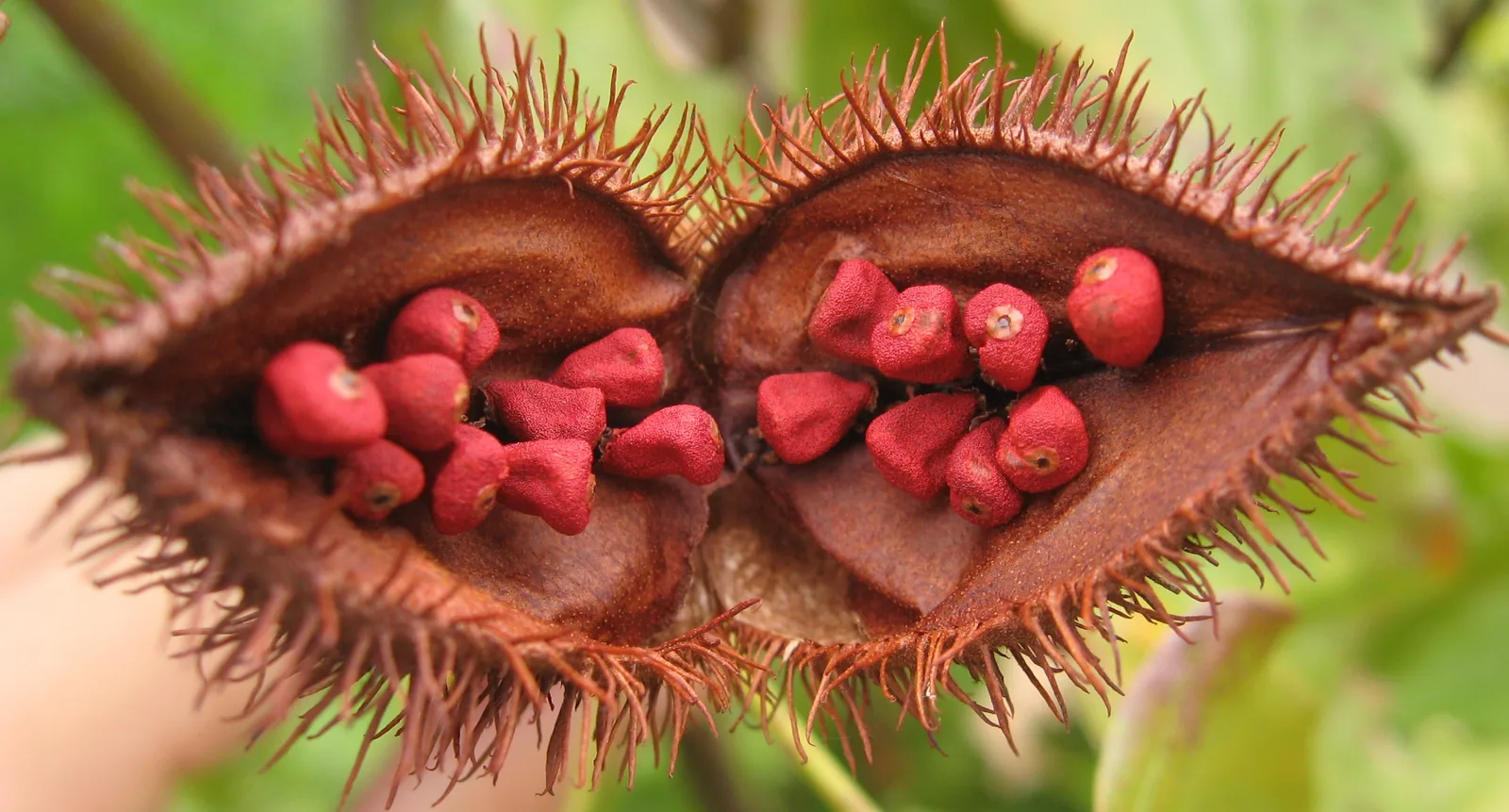
It survives as a living practice today, just not as a clothing dye. Annatto’s coloring is the reason a wedge of Red Leicester cheese or a stick of good butter reads orange instead of pale yellow.
Turmeric: A Bright Orange With a Short Fuse
Turmeric (Curcuma longa) is probably the yellow-orange every reader already knows. It’s the prime example of direct-dye used to illustrate mordant-free bonding. Curcumin bonds straight to fiber with no mordant needed, the same substantive trick onion skin and myrobalan use elsewhere in this piece. On the right fabric it reads convincingly orange, not just yellow. The catch is its washfastness. Turmeric holds up reasonably well against sun but can’t survive a washing machine. Most of the color strips out in the first two or three washes, and what’s left settles into a dull yellow from there, like the gym sock problem. It’s a different failure type than the other dyes in this article, but the same underlying story. A genuine orange that is gone almost as soon as it arrives.
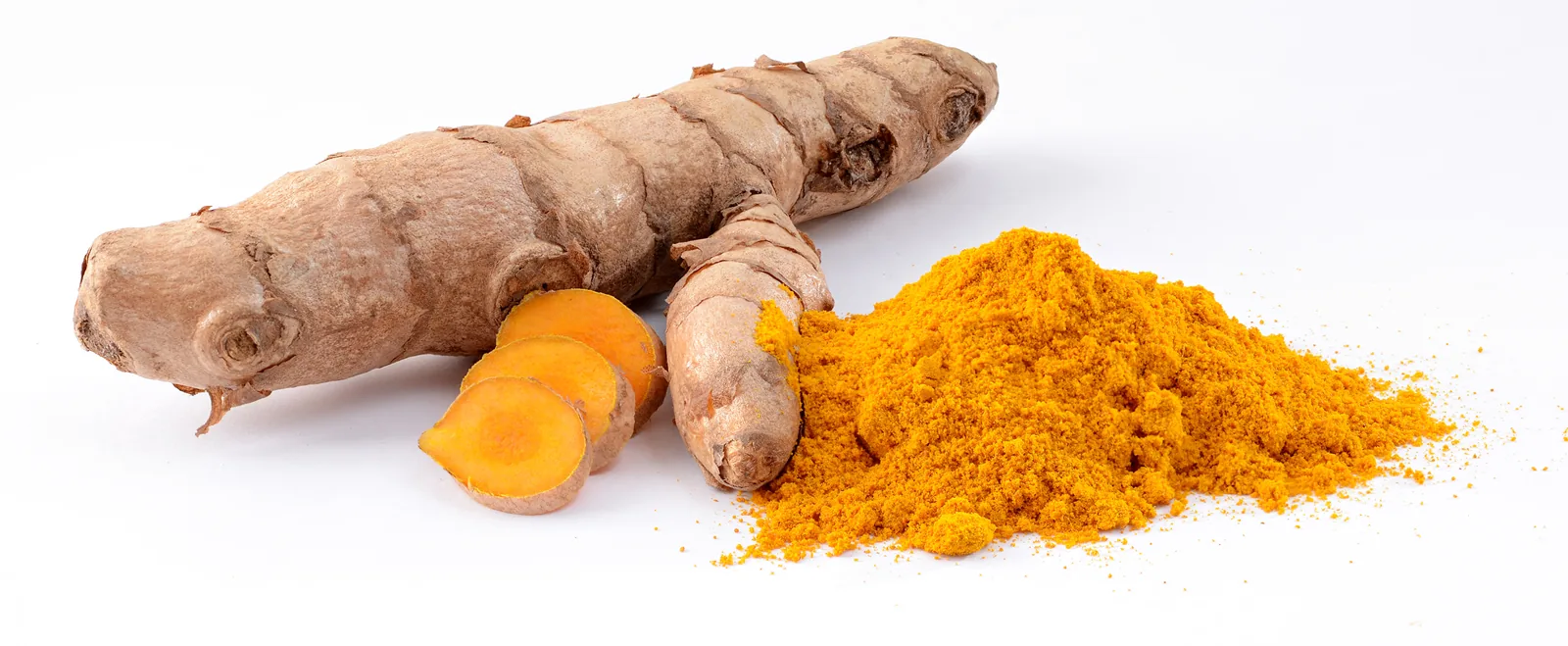
These plants don’t form any real tradition of usage for orange dyes. It is barely a chapter at all in the color spectrum.
Orange’s presence here is not a detour from yellow but the logical end of the same argument. Yellow is difficult because it fades. Orange is difficult because, historically, there was so little of it to lose. And also, it fades.
Why So Little Survives
Put the working set of dyes discussed in this article together and the pattern behind this piece’s title becomes clearer. Every yellow here is real and workable but none are durably lightfast. Orange has the same problem one level worse: not just unstable chemistry, but barely enough source material to describe a tradition at all. Weld is the strongest of the yellows, and even weld is only relatively stable. Annatto is the closest thing orange has to an anchor, and annatto’s textile history is thinner than any single yellow covered here.
That’s most of the mechanism behind yellow and orange’s near-absence from the surviving historical record, though not all of it works the same way. Weld and annatto lost slowly, to sunlight, over decades. Turmeric lost in the washing machine within the first few washes. Safflower never fully committed to being one color to begin with. Marigold’s absence is a combination of its cultural weight and labor economics deciding a color wasn’t worth the investment, despite whatever the plant itself could do. Yellow and orange didn’t disappear from the historical record for one single reason. They each disappeared because none of them could do the full job.
Modern Makers
The yellow tradition survives today less as a flagship color than as a working ingredient in combination with other dyes.
Story mfg. keeps myrobalan, or Kadukkai (கடங்காய்) in Tamil, alive through its Kaduka Dyed collection. Very few pieces in this collection, however, are a true yellow, but have been modified with mordants or combined with additional dyes. The R.T.S. CO-80 colorway, seen on pieces like the Creed Pants and Greenhouse Shirt, uses myrobalan combined with iron for a deep black.
Story mfg. also dyes with jackfruit wood, visible in process photography on its behind-the-scenes account. For this dye, they utilize scrap jackfruit wood discarded by jackfruit agricultural farms. As a classical Tamil word, Palapattai translates to a “mixture, blend, or collection of diverse things.” It mirrors the ethos of this collection, which blends ancient botanical practices with modern, upcycled slow fashion.
45R approaches yellow through Yoikusazome, the brand’s original plant-based dye built from Japan’s traditional seven autumn herbs. One colorway, Golden Lace, is dyed with ominaeshi (Patrinia scabiosifolia), a yellow-flowered plant in that seven-herb set. Its usage as a yellow dye seems to be exclusive to this 45R collection, as there is no other literature discussing its usage as a dye.
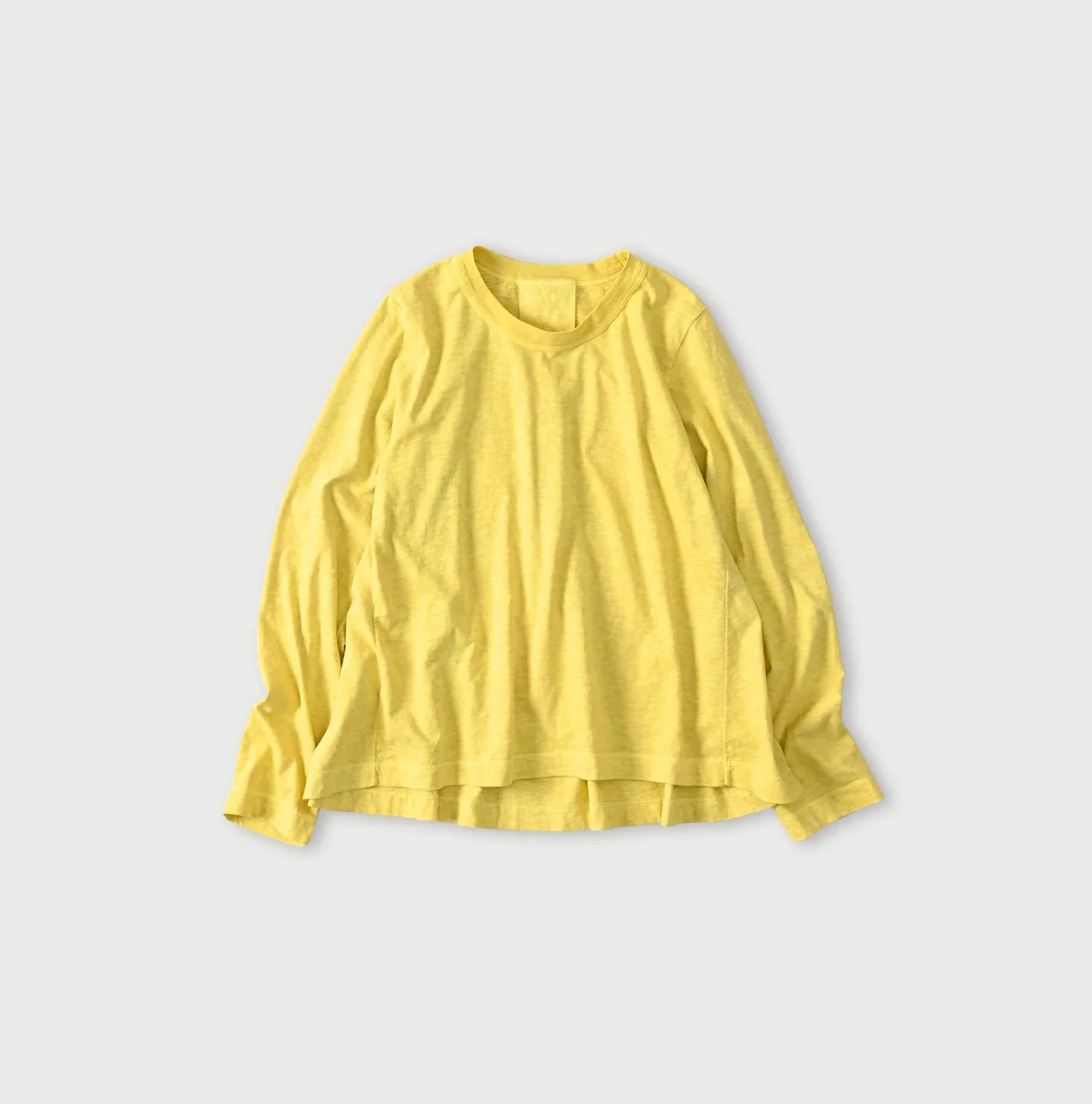
Graziano & Gutierrez is one of the few places where marigold/pericón can be found in menswear. The Portland-based workwear label is built on a direct partnership with weavers in Teotitlán del Valle, Oaxaca, working directly with the indigenous community. Similar to Story mfg., they are not using the dyed fiber as its own statement, but in combination with other dyes or as an overdye, such as in their pintor shirt and pericón camp shirt.
Conclusion: The Colors That Won’t Sit Still
There’s something fitting about colors this skittish being the ones most associated, across cultures, with sunlight itself. Yellow and orange don’t ask you to earn them the way red does, and they don’t reward patience the way the eighty cycles of dorozome reward patience. They just show up bright, do their job, and start fading the moment they’re finished, sometimes within a lifetime, sometimes within a single season of hard light. The same way the sun itself rises every morning without effort and disappears at night no matter how badly you may want to hold onto it.
That isn’t a flaw in either color so much as a description of what they are. Not everything you wear needs to last thirty years to be worth wearing. Some things are meant to be bright while you have them, then quietly become something else. Nothing in life can last forever, and it’s important to enjoy the beautiful things while we have them.
Next in the Dye Series: Tyrian Purple, the color that smelled like death. In the meantime, the Fit Finder is the best way to find denim that fits your body — your actual measurements, not vanity-sized tags.